
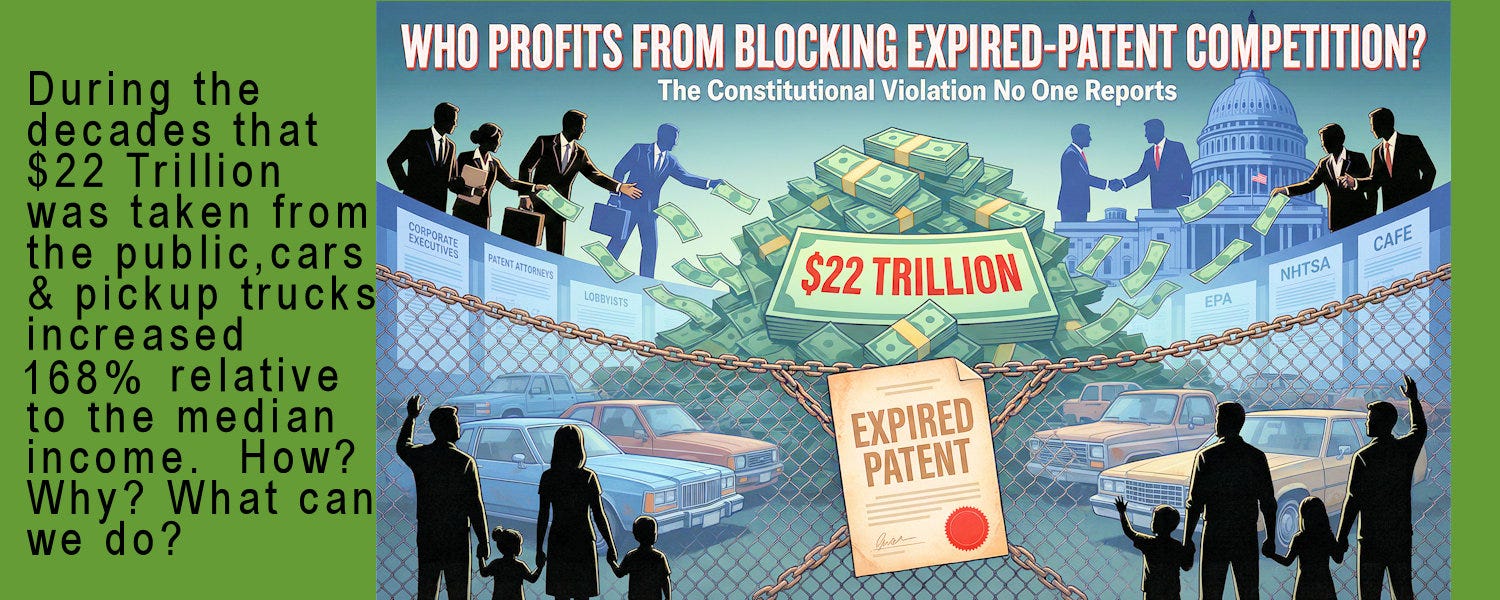
When patents expire, the Supreme Court holds that the public gains “unrestricted rights” to manufacture using those designs. Yet the 1970 Legislative Reorganization Act enabled lobbyists to craft regulatory barriers — with compliance costs of $50–300 million per model — that only incumbent manufacturers can afford, extending patent monopolies indefinitely in violation of the Constitution’s “limited Times” provision. This analysis, with a resolution strategy, reveals an estimated $22 trillion wealth transfer from American consumers to protected industries.
Last modified: 4/23/2026 1:10PM EST
Foreword 4/9/2026
One article not only greatly summarizes this paper but brings you up to the present as of April 2026. It’s a picture only (with captions) booklet.

Preface – Something Very Big Has Happened
On February 9, 2026, AI startup founder Matt Shumer published “Something Big Is Happening“, warning that the AI revolution has already arrived. If you follow AI, this is a most important read. Since the breakthroughs in AI in the last few months, Shumer describes walking away from his computer for four hours and returning to find finished software — not rough drafts, but production-quality work requiring no corrections. He reports that the latest AI models now exhibit something resembling judgment and taste, and that the managing partner of a major law firm told him AI already performs like a team of associates available instantly. Shumer’s conclusion: if your job happens on a screen, AI is coming for significant parts of it — not in ten years, but now.
This article is evidence he’s right. It draws on my decades studying legislative voting technique history and pattern recognition — refined and strengthened by two AI platforms. OpenCase (opencase.com) is a legal research assistant trained on Cornell LII’s authoritative case law database. It provided structured IRAC analysis (the Issue-Rule-Application-Conclusion framework lawyers use to test legal arguments) that identified doctrinal weaknesses, suggested counter-precedent, and stress-tested the constitutional argument with the rigor of a law review editor. Unlike general-purpose AI tools, which a Stanford study found hallucinate 58–82% of the time on legal queries, OpenCase grounds its analysis in authenticated case law and flags uncertainty rather than fabricating citations. Anthropic’s Claude Sonnet 4.5 and Opus 4.6 then handled citation verification, economic analysis, and editorial refinement. Together, my pattern-recognition expertise, OpenCase’s legal analysis, and Claude’s editorial refinement accomplished in a week what would have required months of solo research.
On a personal note, using these advanced AI engines (Claude Opus 4.6 and OpenCase) is akin to providing me with a world class legal team and world class editorial assistance. To get this article done within a 2 week period, I had to upgrade to Claude Max. This is way more advanced AI work than SuperGrok on X can currently do. I did have SuperGrok and Llama review the article though (5 LLMs in all). This article has cost me an extra $110 in this month-alone charges for extra-use of AI engines, but the output I was able to achieve justifies it in my opinion. Of the hundreds of articles I have written in my life, I am most proud of this. It conveys so much of my lifelong research but tightly organized. If I died tomorrow, I’d want this article to be my legacy (for now, but future articles might cause a change of mind).
Background – Seeing something massive that nobody else reports
Something is profoundly wrong with how American patent law operates—but nobody saw it because they were looking in the wrong place. When patents expire, Supreme Court precedent is crystal clear: the public gains “unrestricted rights” to manufacture using those designs. Yet Americans pay $22 trillion more for vehicles and machinery than patent expiration economics would predict. (See Section VI for Calculations). The Constitution’s “limited Times” provision should mean designs whose patents expired 20+ years ago become freely manufacturable.
Before 1970, expired-patent remanufacturing was legal, though rarely practiced due to strong competition and affordable vehicle prices. However, EPA emissions standards, NHTSA safety requirements, and DOE efficiency mandates created permanent barriers — not explicit prohibitions, but total development and compliance costs, including R&D and testing, of $50–300 million per model that only incumbent manufacturers can afford. Patent monopolies that should have ended decades ago continue indefinitely, blocking the competitive price collapse the Framers promised would follow expiration.
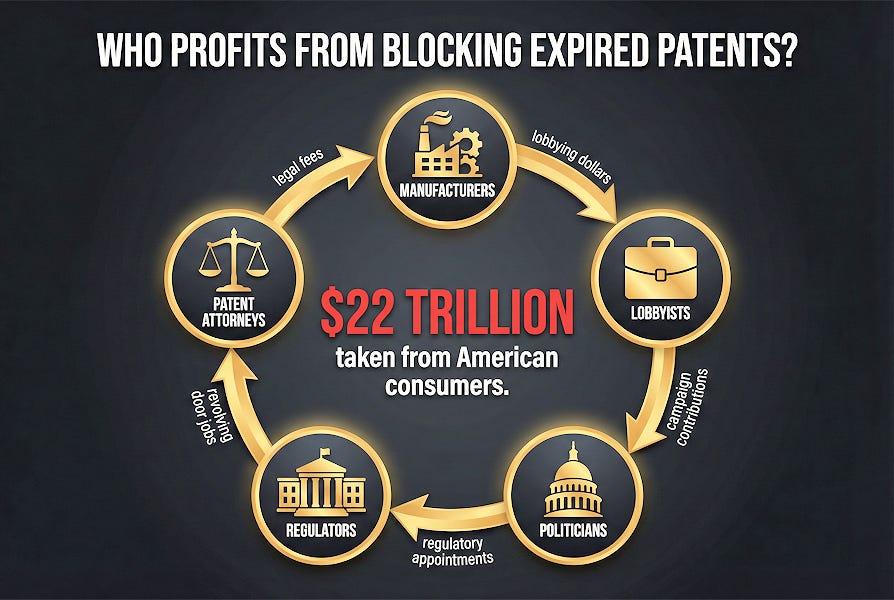
This article presents what appears to be the first analysis, with a resolution strategy, connecting patent law’s expiration doctrine with regulatory law’s compliance costs to reveal an unprecedented constitutional violation. Comprehensive research found zero congressional hearings examining whether post-1970 regulations violate the Patent Clause, zero law review scholarship, and zero academic examination despite the $22 trillion wealth transfer. The silence is deafening—and profitable. Manufacturers, patent attorneys, lobbyists, politicians, and media outlets (the “five profiteers”) have built a trillion-dollar coalition that depends on this violation remaining invisible.
Introduction: The Constitutional Promise That Disappeared
In 1906, Upton Sinclair’s The Jungle exposed horrifying conditions in America’s meatpacking plants. Public outrage forced Congress to pass the Pure Food and Drug Act within months. In 1902, Ida Tarbell’s exposé of Standard Oil’s monopolistic practices led to the company’s breakup under antitrust law. Lincoln Steffens’ 1904 articles on municipal corruption sparked the Progressive Era’s reform movement. In each case, a hidden truth—once revealed—generated unstoppable public pressure for change.
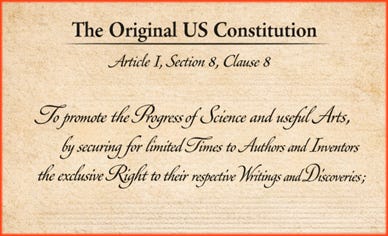
Today, America faces another hidden truth of similar magnitude: post-1970 federal regulations have systematically nullified the Constitution’s promise that patent monopolies exist only for “limited Times” (see Figure 1), creating an estimated $22 trillion wealth transfer from consumers to incumbent manufacturers and their benefactors — the five profiteers (see Background).[1] This is a documented constitutional crisis supported by Supreme Court precedent, international evidence, and basic economic analysis.
The constitutional violation operates through a deceptively simple mechanism: While vehicle design patents expire after twenty years as the Constitution requires, post-1970 regulatory frameworks—EPA emissions standards, NHTSA safety requirements, DOE efficiency mandates, and CAFE standards—make it impossible to manufacture those expired designs.
The regulations do not explicitly prohibit expired-patent use. Instead, they require any “new” product (including remanufactured designs) to meet current-year standards, imposing certification costs of $50-300 million per model [2]—costs only incumbent manufacturers can absorb. The result: patent monopolies that were constitutionally required to end in 2004 continue indefinitely, preventing the competitive price collapse that the Framers promised would follow patent expiration.
This Article makes four core arguments:
· First, post-1970 regulations violate the Patent Clause’s structural limitation by extending patent monopolies beyond their constitutional “limited Times” without congressional authorization, triggering heightened scrutiny under the Major Questions Doctrine established in West Virginia v. EPA and reinforced in Loper Bright Enterprises v. Raimondo.
· Second, the comprehensive institutional silence protecting this violation—zero congressional hearings, zero investigative journalism, zero academic scholarship—reflects rational profit-maximizing behavior by each institution: profiteers engineered the system, academia cannot see across disciplinary silos, media protects $20.8 billion in automotive advertising revenue [3] and Congress is captured by lobbying which exploded from 175 registered lobbyists in 1971 to 13,070 in 2024—a 7,400% increase.
· Third, international evidence proves the economic impact: countries permitting patent-expired remanufacturing offer vehicles at dramatic savings compared to U.S. equivalents (see Section IV). The constitutional promise works everywhere it is allowed. It fails in America because regulations prevent it from working. (See “Countries with newly remade patent-expired cars and trucks for sale”).
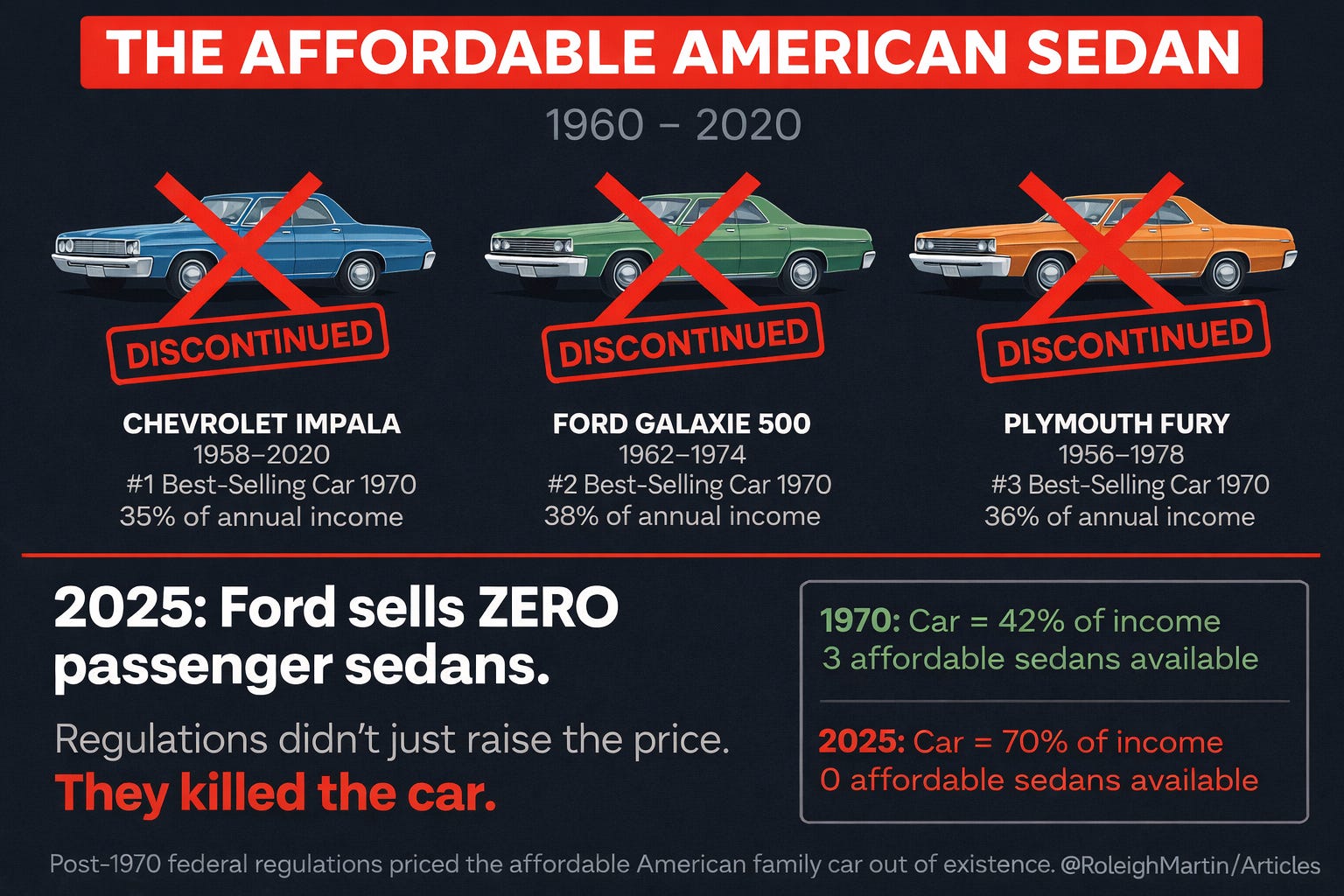
· Fourth, the real-world affordability impact is devastating and precisely dated in domestic automotive price history. From 1960 to 1970, new cars were becoming more affordable relative to median male earnings—falling from 48% to 42% of annual income. After 1970, this trend violently reversed: by 2025, the average new vehicle consumes over 70% of median male earnings, a 1.68x worsening [15]. Worse still, the affordable full-size American sedans that dominated the 1970 market—the Impala, Galaxie 500, and Fury—have not merely become more expensive; post-1970 regulations eliminated them entirely (see Section V below).
Part II establishes the constitutional framework, demonstrating that the Patent Clause is not merely a grant of power but a structural limitation preventing perpetual monopolies.
Part III documents the comprehensive silence and analyzes why each institution stays silent.
Part IV presents international and domestic evidence.
Part V examines the 1970 inflection point and affordability impact.
Part VI examines the economic calculation.
Part VII addresses standing, justiciability, and multiple litigation pathways.
Part VIII proposes remedies.
Part IX advocates a Structural Fix: Constitutional Hybrid Voting
Part X concludes.
The meatpacking industry, Standard Oil, and municipal corruption machines all collapsed once the public understood the truth. This Article provides that truth for the post-1970 regulatory regime that has systematically violated the Patent Clause for over fifty years.
II. The Patent Clause as a Structural Limitation on Federal Power
A. The Constitutional Bargain: Temporary Monopoly for Permanent Public Benefit
The Patent Clause (see Figure 1 above) grants Congress the power “To promote the Progress of Science and useful Arts, by securing for limited Times to Authors and Inventors the exclusive Right to their respective Writings and Discoveries.” This is the only explicit monopoly authorization in the Constitution—and it comes with a non-negotiable time limit.
The Supreme Court has repeatedly emphasized that this limitation is structural, not discretionary. In Graham v. John Deere Co., the Court explained that the Patent Clause reflects “both a grant of power and certain limitations upon the exercise of that power.” The Framers “sacrificed” state sovereignty over intellectual property “in favor of a single federal system” precisely to ensure that monopolies would be temporary and uniform. Thomas Jefferson articulated the principle: “Inventions then cannot, in nature, be a subject of property.”
The bargain is explicit: inventors receive a twenty-year monopoly in exchange for public disclosure. After expiration, the invention enters the public domain. This is not a legislative grace—it is a constitutional promise. As the Court held in Kimble v. Marvel Entertainment, “the unrestricted right to make or use the article passes to the public” upon expiration. In Scott Paper Co. v. Marcalus Manufacturing Co., the Court confirmed that expired patents “become public property” which “all are free to use.” And in Brulotte v. Thys Co., the Court invalidated any contractual attempt to extend patent rights post-expiration, holding such arrangements “per se unlawful.”
One Scott Paper passage deserves its own paragraph because it is the single most powerful sentence in all of American patent law for the constitutional argument this Article advances. Writing for the Court in 1945, Chief Justice Harlan F. Stone declared that "any attempted reservation or continuation in the patentee or those claiming under him of the patent monopoly, after the patent expires, whatever the legal device employed, runs counter to the policy and purpose of the patent laws." Read that sentence twice. Whatever the legal device employed. Eighty-one years ago — before EPA, before NHTSA, before DOE, before CAFE standards, before any of the regulatory frameworks this Article documents existed — Chief Justice Stone anticipated the exact kind of workarounds incumbent industries and captured agencies would later invent to extend expired patent monopolies through mechanisms other than the patents themselves. He named those mechanisms in advance with a single phrase — whatever the legal device employed — and ruled them unlawful before they were invented. The "legal device" Stone foresaw is the post-1970 regulatory ratchet. Section II.B and the rest of this Article spell out, in detail, what Chief Justice Stone in 1945 already knew was unconstitutional.
The doctrinal move this article asks the courts to make is an extension of Scott Paper, Brulotte, and Kimble from the private legal devices those cases struck down — assignment clauses, royalty contracts, licensing restraints — to the regulatory devices that now perform the same post-expiration blockade by different means. Chief Justice Stone’s phrase in Scott Paper — “whatever the legal device employed” — is textually broad enough to reach a compliance wall erected by EPA, NHTSA, and DOE rules, and the logic of the Clause makes no distinction between a private party and a federal agency when the effect on the expired patent is identical.
The doctrine is clear: Congress may not extend patents beyond their limited term. The question this Article addresses is whether Congress may delegate to administrative agencies the power to impose regulations that render expired patents economically unusable, thereby achieving through regulatory barriers what the Constitution forbids directly.
The Supreme Court’s analysis in Eldred v. Ashcroft, 537 U.S. 186 (2003), reinforces this conclusion. Eldred drew a critical distinction: Congress may extend terms before they expire, but once expiration occurs, the public’s rights are permanent and irrevocable. Both the majority and Justice Stevens’s dissent share this premise.
Post-1970 regulations achieve precisely what Eldred’s framework forbids: they restore effective monopoly control over designs that have already entered the public domain by making their manufacture economically impossible. The mechanism differs — regulatory barriers rather than statutory term extension — but the constitutional result is identical.
Designs the Patent Clause released to the public are locked away from public use, not by extending the patent term on paper, but by erecting compliance barriers that only the original monopolists can afford to clear.
B. The Regulatory Workaround: How Agencies Extended Patents Without Amending the Patent Act
Before 1970, manufacturing vehicles using expired-patent designs was legal, though market evidence suggests it was rarely practiced - not because regulations prevented it, but because strong competition and affordable pricing eliminated market incentives.
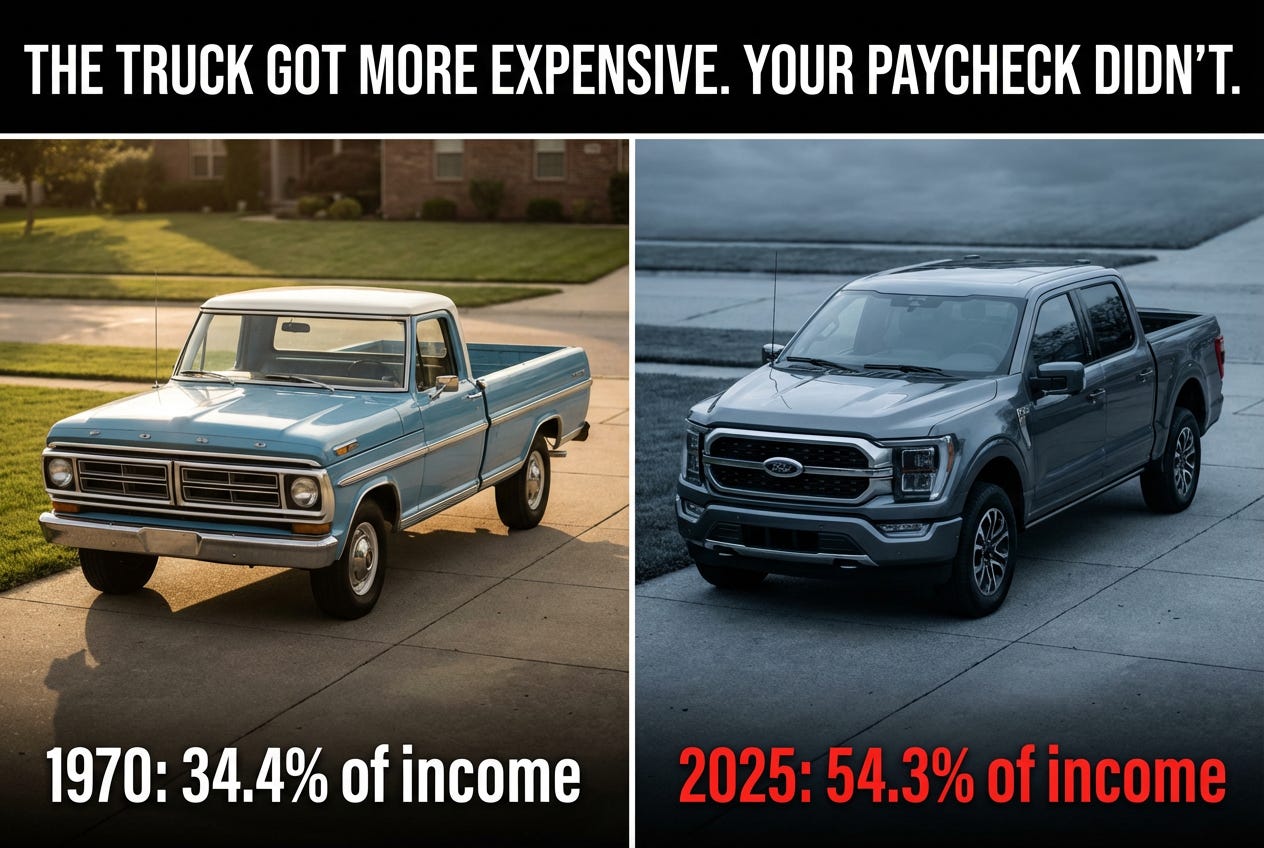
A Ford F-100 pickup truck in 1970 cost a median male worker about one-third of his annual income; today the F-150 costs over half (see Section V for detailed analysis).[4]
Post-1970 regulatory frameworks do not explicitly prohibit the manufacture of patent-expired designs. Instead, they require compliance with current-year standards as a condition of market entry, creating insurmountable economic barriers [5,6]:
· The Clean Air Act Amendments of 1970 authorized EPA to set emissions standards for “new motor vehicles,” which EPA defined to include any vehicle manufactured for initial sale—including exact copies of twenty-year-old designs.
· The Energy Policy and Conservation Act of 1975 established Corporate Average Fuel Economy (CAFE) standards, requiring manufacturers to meet fleet-wide fuel efficiency targets.
· The Federal Motor Vehicle Safety Standards (FMVSS), expanded throughout the 1970s-1990s, impose hundreds of design requirements on “new” vehicles regardless of whether the underlying design is patent-expired.
· The Department of Energy’s appliance efficiency standards, authorized by the National Energy Conservation Policy Act of 1978, similarly require current-year compliance for any “new” appliance.
Each regulation appears facially neutral. But the aggregate effect is not merely to burden competitors — it is to make patent-expired designs illegal to manufacture at all. This is the “regulatory ratchet“ — a one-way mechanism where standards only tighten, never grandfather existing designs, so that every expired patent enters a public domain that cannot legally be used. A 2004 Ford F-150 (patents expired 2024) cannot be built by anyone — not even Ford itself. CAFE standards now require 40–50% better fuel economy, FMVSS mandates equipment that didn’t exist in 2004 (electronic stability control, backup cameras, tire pressure monitoring), and EPA Tier 3 emissions standards supersede the Tier 2 standards the engine was designed for [6]. The constitutional promise of patent expiration has been rendered a nullity.
C. Why This Violates the Patent Clause
The constitutional violation is not that regulations impose safety or environmental requirements. The violation is that regulations impose those requirements in a manner that functionally extends patent monopolies beyond their limited term. Three factors demonstrate this:
1. First, regulatory requirements apply retroactively to designs that complied with all applicable law during their patent term. A 2004 F-150 met every federal requirement when manufactured. Patents have now expired. The Constitution promises public access. But regulations require a hypothetical remanufacturer to meet 2026 standards.
2. Second, the compliance burden fails asymmetrically on new entrants. Ford can amortize certification costs across millions of units. A startup faces the same $150-300 million burden but serves a narrower market.
3. Third, international evidence proves these barriers are not inherent to safety. Multiple countries permit purchasing remanufactured patent-expired vehicles while maintaining appropriate standards — at a fraction of U.S. prices (see Section IV-A for country-by-country evidence). See “Countries with newly remade patent-expired cars and trucks for sale.”
The Supreme Court confronted analogous reasoning in Sheetz v. County of El Dorado, holding that permit conditions must bear a proportional relationship to the government’s stated interest. Here, requiring twenty-year-old designs to meet 2026 standards bears no relationship to promoting innovation (the patent has expired) and directly contradicts the constitutional promise of public access.
D. The Major Questions Doctrine
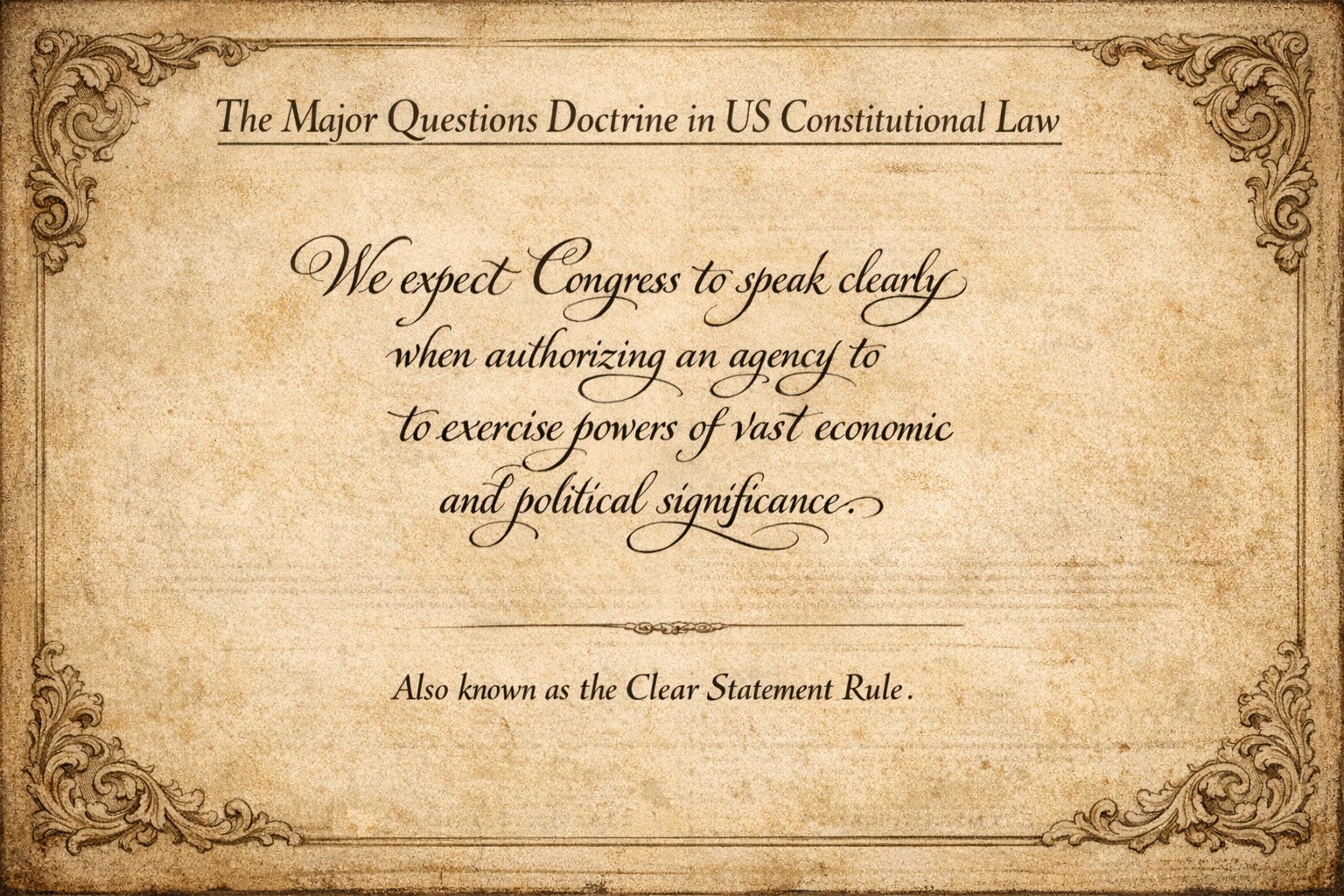
In West Virginia v. EPA, the Supreme Court held that agencies must point to “clear congressional authorization” for decisions of vast “economic and political significance.” Eliminating public access to expired patents across entire economic sectors plainly constitutes such a decision.
Congress never explicitly authorized EPA, NHTSA, or DOE to impose compliance requirements that would functionally extend patent monopolies. The Court in Loper Bright Enterprises v. Raimondo eliminated Chevron deference, requiring courts to independently determine statutory meaning. The best reading cannot be that Congress silently delegated authority to nullify a core constitutional limitation.
If Congress itself cannot extend patents beyond their limited term, it cannot delegate that power to agencies through ambiguous statutory language about “new motor vehicles.” The Major Questions Doctrine should apply with even greater force when agency action conflicts with explicit constitutional limitations.
This analysis anticipates the strongest counterargument: that EPA, NHTSA, and DOE regulations are valid exercises of Commerce Clause power under Wickard v. Filburn, 317 U.S. 111 (1942), and Hodel v. Virginia Surface Mining, 452 U.S. 264 (1981), and that the Patent Clause constrains only patent grants, not Congress’s separate regulatory authority.
However, this argument fails for a fundamental reason: when a specific constitutional limitation conflicts with a general grant of power, the specific provision controls. The First Amendment limits otherwise valid Commerce Clause regulation of speech. The Second Amendment limits otherwise valid Commerce Clause regulation of firearms. The Patent Clause’s “limited Times” provision likewise limits otherwise valid Commerce Clause regulation when the practical effect is to extend patent monopolies beyond their constitutional expiration.
Congress may regulate vehicle safety and emissions under the Commerce Clause. What it may not do — directly or through delegation to agencies — is exercise that power in a manner that functionally nullifies a separate, specific constitutional limitation.
The Supreme Court has never held that Commerce Clause authority overrides the Patent Clause’s structural constraints, and Loper Bright’s elimination of Chevron deference ensures courts must now independently evaluate whether agency regulations exceed these constitutional boundaries.
III. The Constitutional Violation No One Reports
The constitutional principles governing patent expiration are not obscure. They are among the most clearly established doctrines in American intellectual property law. The Supreme Court has repeatedly affirmed that once patents expire, their subject matter enters the public domain “free for all to use.” See Bonito Boats, Inc. v. Thunder Craft Boats, Inc., 489 U.S. 141, 152 (1989). Generic pharmaceuticals demonstrate this principle daily: when drug patents expire, prices collapse 80-90%.[7] Calculator patents tell an even more dramatic story (see Section IV-B).
Given this crystal-clear constitutional doctrine, one would expect robust reporting and scholarship examining how regulatory barriers prevent the public from exercising these rights. One would expect congressional hearings investigating whether EPA, NHTSA, and DOE regulations comply with the Patent Clause.
That reporting does not exist. That scholarship does not exist. Those hearings have never occurred.
A. The Silence is Comprehensive—and Profitable
· Congressional Testimony: Zero hearings since 1970 examining whether regulatory barriers to expired-patent remanufacturing violate the Patent Clause. Not one of 535 legislators has publicly questioned whether compliance requirements functionally extend patent monopolies.[8]
· Investigative Journalism: Zero major investigations. The New York Times, Washington Post, Wall Street Journal, ProPublica—none have examined why Americans cannot access $6,000-15,000 vehicles available in other countries using patent-expired designs.[9]
· Law Review Articles: Zero academic scholarship connecting patent expiration to regulatory compliance costs in transportation sectors.[8]
· Congressional Oversight: Not a single GAO report or CRS analysis examining whether post-1970 regulations comply with constitutional limits on patent duration.[10]
The silence is comprehensive. And the silence is profitable—protecting $22 trillion in wealth transfer by ensuring that each institution with the power to expose the violation has strong financial or institutional incentives not to do so.
B. Why the Profiteers Stay Silent: They Engineered It
The five profiteers—incumbent manufacturers, patent attorneys, lobbyists, regulators and politicians—do not merely benefit from the regulatory regime. They actively created it through systematic lobbying following the 1970 Legislative Reorganization Act (LRA). See my article, “The Congressional Research Institute on how Congress became controllable in 1971.”

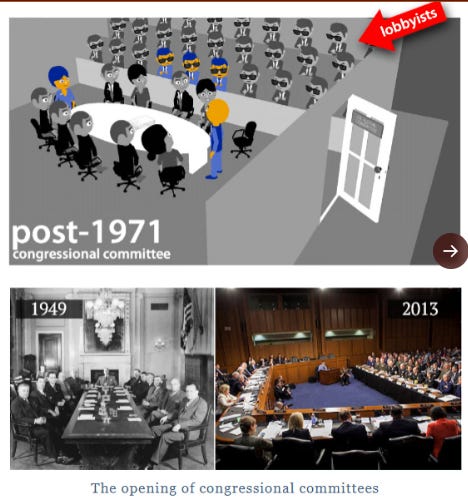
Before 1971, congressional deliberations occurred largely in closed sessions. The 1970 LRA changed everything, as a 2019 landmark Foreign Affairs article by James D’Angelo and Brent Ranalli reported. It required recorded votes and open proceedings, giving special interests enforcement power. Lobbying exploded from 175 registered lobbyists in 1971 to 13,070 in 2024—a 7,400% increase.
The LRA’s impact was immediate. With their newfound ability to track and pressure legislators through recorded vote scorecards, lobbyists began pushing regulations that would protect incumbent industries. Within five years, Congress passed the Clean Air Act Amendments (1970), the Energy Policy and Conservation Act establishing CAFE standards (1975), and created the Department of Energy (1977). The Federal Motor Vehicle Safety Standards expanded throughout the 1970s-1990s. The regulatory wall blocking expired-patent competition was complete by the mid-1980s.
The five profiteers stay silent because exposure threatens their income:
• Manufacturers would face competition collapsing their pricing power. The automotive industry collectively spends over $125 million annually on lobbying and campaign contributions. [11,14,22]
• Patent attorneys would lose billable hours generated by regulatory complexity.
• Lobbyists would lose million-dollar contracts maintaining the status quo.[12]
• Politicians would lose campaign contributions from threatened industries.[13]
• Regulators would lose revolving door opportunities and industry cooperation that ensure post-government employment.
The profiteers do not need to conspire. They simply act rationally to maximize their own benefit. But the aggregate result is constitutional nullification and massive wealth transfer.
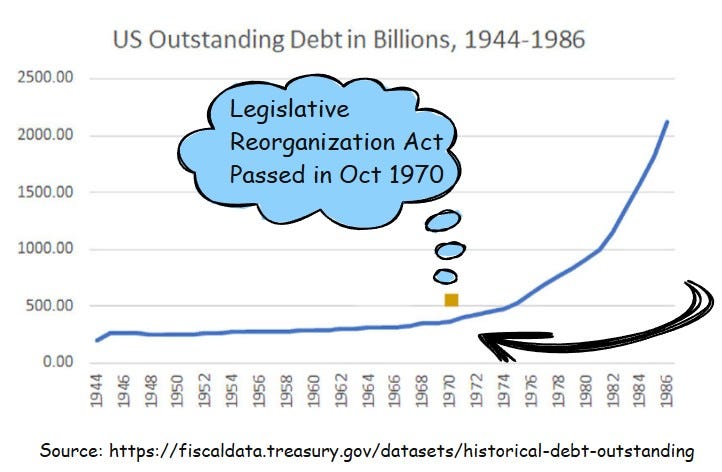
As documented earlier, before the LRA took effect on January 3, 1971, Congress reduced the national debt 80 times over 180 years, with its last debt-reducing fiscal year being 1957. This correlation between the LRA’s transparency reforms and the post-1970 regulatory explosion reveals how lobbyist capture enabled the regulatory regime that blocks patent-expired competition.
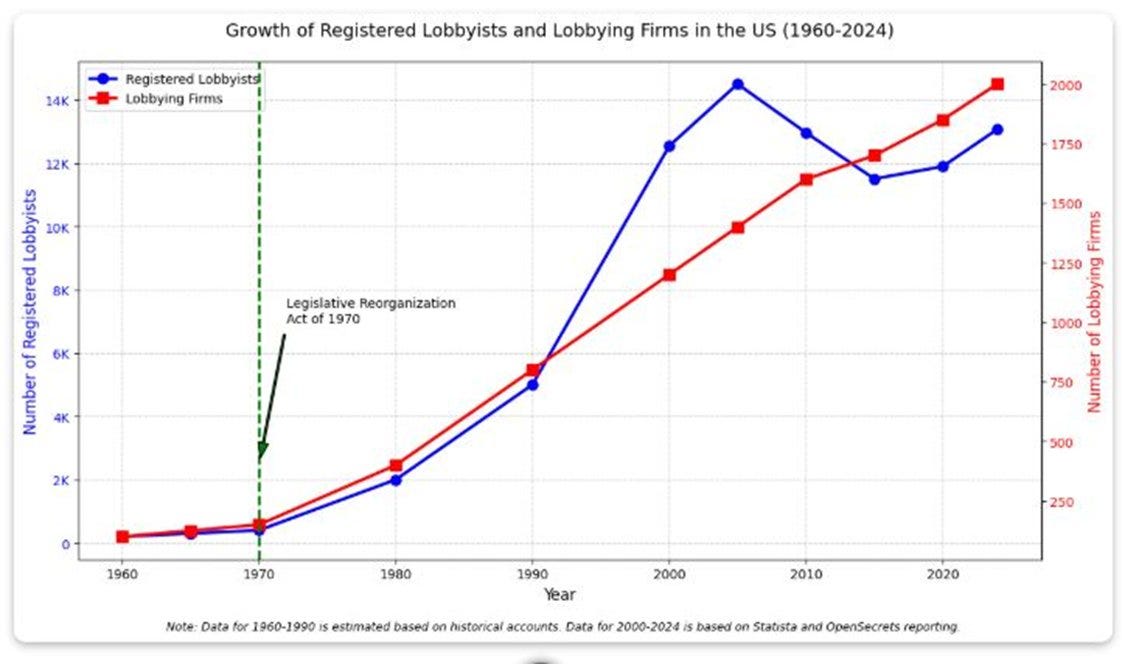
Also correlating with the growth in lobbyists is a noticeable spike in government debt, starting with the same period of time. See my article, “Why the 19th Century Congress Was So Populist-Radical About National Debt”.
C. Why Academia Doesn’t See It: Disciplinary Silos Serve the Status Quo
Patent law scholars focus on patent term, claim construction, and infringement—not on whether regulatory compliance costs prevent use of expired patents. Regulatory law scholars focus on environmental protection, consumer safety, and administrative procedure—not on whether regulations violate the Patent Clause. Constitutional scholars analyze patent term extensions explicitly enacted by Congress (e.g., the Hatch-Waxman Act) but not regulatory workarounds that achieve the same result.
Standard patent law textbooks discuss the twenty-year term and Brulotte’s prohibition on post-expiration royalties. However, they do not examine whether EPA/NHTSA/DOE regulations that make expired-patent use economically impossible violate the “limited Times” requirement.
The academic reward structure reinforces these silos. Patent scholars publish in intellectual property journals. Environmental scholars publish in environmental law journals. Constitutional scholars publish in constitutional law journals. A scholar attempting to synthesize across all three risks being dismissed as lacking expertise in each individual domain.
This disciplinary structure serves incumbent interests. As long as patent scholars study patent law, regulatory scholars study regulatory law, and constitutional scholars study constitutional law—without examining their interaction—the constitutional violation remains invisible.
Research conducted in January–February 2026 examined congressional hearing databases (Congress.gov, GovInfo), law review databases (HeinOnline, JSTOR, Westlaw, LexisNexis), and academic publishers. The result: zero congressional testimony, zero law review articles, and zero academic books examining whether post-1970 regulatory requirements — EPA emissions standards, NHTSA safety requirements, CAFE fuel economy mandates — create barriers preventing public use of patent-expired vehicle designs. No one has asked whether these regulations violate the Patent Clause’s “limited Times” provision or the Supreme Court’s guarantee of “unrestricted” public access post-expiration.
The Data Gap Preventing Empirical Analysis
The academic failure to understand why the nation’s debt spiraled out of control after 1970 versus Congress’s highly respectable fiscal maturity before 1970 are due to an inability to categorically understand how Congress worked before it digitized itself in the 1970s. The data needed to analyze Congressional behavior across the 1970 divide is systematically inaccessible—even to artificial intelligence.
Large Language Models (LLMs) like Grok, ChatGPT, and Claude lack comprehensive access to Congressional voting records and committee proceedings prior to 1973, particularly unrecorded votes, voice votes, and closed committee deliberations that characterized pre-LRA governance. Modern digital databases (Congress.gov, GovInfo) only provide detailed records from 1989-1990 forward. Earlier records exist in fragmented historical archives like the Annals of Congress, Congressional Globe, and Congressional Record, but these are not digitized in machine-readable formats accessible to LLMs.
This creates a systematic barrier to the empirical analysis that could definitively test this article’s central thesis: that the 1970 Legislative Reorganization Act’s transparency reforms enabled the lobbying capture that prevents debt reduction and constitutional compliance.
A detailed proposal, “If DOGE audits Congress, scan its history to reveal why it can’t cut debt,” developed through AI-assisted research recommends a $25 million federal appropriation to digitize the complete Congressional voting record since 1789, build a comprehensive database, and integrate it into LLM training datasets. The project would require an additional $1.5 million annually for maintenance and updates. This investment would enable political scientists, economists, and AI systems to conduct rigorous comparative analysis of pre-LRA versus post-LRA voting patterns, committee behavior, lobbying influence, and fiscal outcomes.
D. Why the Media Doesn’t Report It: Follow the Advertising Money
The automotive industry spends approximately $20.8 billion annually on U.S. advertising.[3] Major media outlets receive substantial revenue from automakers. Investigative journalism exposing that regulatory barriers prevent $6,000-15,000 vehicles from entering the market would directly threaten this revenue stream.
The story also does not fit traditional journalistic beats. It requires expertise in patent law (legal beat), environmental regulation (environment beat), automotive industry economics (business beat), and constitutional structure (politics beat). No single reporter possesses this combination. Investigative teams capable of synthesizing across domains are expensive and increasingly rare.
Moreover, the story challenges conventional narratives. Progressive outlets champion environmental regulation; conservative outlets champion deregulation. This thesis argues that environmental and safety regulations can be simultaneously legitimate in purpose and unconstitutional in application. Neither side’s standard framework accommodates this nuance.
The result: comprehensive media silence, protecting the $22 trillion wealth transfer from scrutiny.
E. Why Congress Doesn’t Investigate: The 1970 LRA Made Them Controllable
The lobbyist enforcement power documented in Section III-B created a political economy that makes congressional investigation impossible: concentrated benefits for manufacturers (billions in protected pricing), diffused costs for consumers (hundreds or thousands per household), and precise vote-tracking that made defying special interests politically suicidal.
The Regulatory Explosion: The timing of post-LRA regulations is not coincidental. [5,6,16]
- 1970: Clean Air Act amendments (signed December 31, 1970)
- 1973: Electronic voting introduced in the House
- 1975: Corporate Average Fuel Economy (CAFE) standards enacted
- 1977: Department of Energy created, expanding regulatory reach
- 1990: Clean Air Act Amendments dramatically increased emissions requirements
- 2007: Energy Independence and Security Act (EISA) mandating 40% fuel economy increase by 2020
- 2012: Harmonized EPA/NHTSA standards for greenhouse gas emissions and fuel economy
- 2024: Standards requiring 50.4 mpg by 2031
According to the Congressional Research Institute’s landmark 2019 study in Foreign Affairs, reviewed in my article, “The Congressional Research Institute on how Congress became controllable in 1971”, the LRA transformed Congress from “one of the most closed institutions in history to one of the most open”—and in doing so, made legislators “significantly more susceptible to the influence of powerful outsiders.”
Not a single member of Congress has publicly questioned whether post-1970 regulations violate the Patent Clause. This is not because 535 legislators independently concluded the regulations are constitutional. It is because the 1970 LRA made opposing trillion-dollar industries politically suicidal.
A congressman who proposes allowing $6,000-15,000 vehicles into the market faces immediate opposition: lost contributions, attack ads funded by industry PACs, and primary challenges from industry-supported opponents.
The 1970 LRA made all of this traceable and enforceable.
Congress is not corrupt in the traditional sense. Members simply respond rationally to the incentive structure the LRA created. But the result is constitutional abandonment: the branch responsible for checking executive overreach cannot do so when lobbyists control the recorded vote.
F. The Manufacturer’s Goldmine: Permanent Monopoly Pricing
For vehicle manufacturers, the current regulatory regime is a dream come true: all the benefits of patent protection with none of the constitutional time limits.
Consider the economics. When Texas Instruments’ calculator patents expired in the 1990s, competitors flooded the market with affordable alternatives. Prices plummeted. Competition thrived. This is exactly what the Founding Fathers intended when they wrote “limited Times” into the Patent Clause. See my article, “Truck vs Calculator Prices: The Hidden War on Expired Auto Patents”.
But in the automotive industry, no such competition exists. Ford, GM, Toyota, Honda—these manufacturers enjoy effective perpetual exclusivity because post-1970 regulations make it economically impossible for new entrants to manufacture vehicles based on expired-patent designs from the 1970s, 1980s, or even 1990s.
The financial benefits to incumbent manufacturers are staggering:
Protected Pricing Power: Without competition from lower-cost remanufactured vehicles, manufacturers maintain pricing power that would otherwise erode. As detailed in Section V, the average new vehicle now consumes over 70% of median male earnings—a dramatic worsening from 1970. This ratio would collapse if expired-patent competition were permitted, just as it did in the calculator market.
Market Share Protection: New entrants using expired patents could offer basic, reliable transportation at $10,000-$12,000 per vehicle (based on 2004-era standards), according to economic modeling. This would devastate the market share of current manufacturers, who depend on selling higher-priced vehicles with mandatory modern features.
Regulatory Capture Benefits: Incumbent manufacturers shaped the very regulations that now protect them. They lobbied for ever-stricter emissions standards, safety requirements, and fuel economy mandates—knowing they had the resources to comply while potential competitors using expired designs could not.
The numbers speak for themselves. If expired patents enjoyed remanufacturing, bringing into the market that competition plus causing new items to be discounted so they could compete, the estimate is that consumers would have saved $22 trillion. That $22 trillion didn’t disappear—it transferred from consumer pockets to manufacturer revenues and shareholder returns.
Remember, we’re talking about more than cars and pickup trucks. We considered the broader transportation and machinery sectors—commercial trucks, farm equipment, RVs, trailers, residential and commercial appliances, and heavy machinery subject to similar regulatory barriers.
Every year this system persists, manufacturers extract hundreds of billions in excess costs from consumers who have no choice but to pay. This isn’t innovation being rewarded. This is constitutional theft being protected by regulatory barriers.
G. Historical Precedent: The 1980s Gray Market Suppression
The automotive industry’s pattern of using regulatory barriers to eliminate price competition has historical precedent. In the 1980s, Mercedes-Benz faced a threat remarkably similar to patent-expired competition: gray market imports. [17,18,19,20,21]
Gray market vehicles were functionally identical Mercedes models—500SELs, G-Class SUVs, European-spec sedans—sourced directly from Europe and modified by independent shops to meet U.S. standards. They offered the same legendary German engineering, the same quality, the same performance as dealer-sold vehicles. The only difference? They cost $7,000 to $10,000 less.
By 1985, gray market imports had captured an astonishing 20 percent of Mercedes-Benz’s U.S. market. That year alone, approximately 66,900 gray market vehicles entered the United States—with 20,000 of them bearing the three-pointed star. The financial impact was staggering: Mercedes-Benz of North America faced an estimated $300 million annual loss to these independent importers who offered American consumers the exact same vehicles at dramatically lower prices.
Mercedes-Benz’s response followed the exact playbook later used to block patent-expired manufacturing: lobby for regulations framed as consumer protection that effectively eliminate competition.
In 1984, Mercedes spokesman A.B. Schuman launched the company’s public relations offensive, warning that “manufacturers are trying to warn gray market customers of the pitfalls.” The framing was deliberate. Not “these are dangerous vehicles” but “these shops might not do the work properly.” The actual product was identical; only the source differed. But by raising vague concerns about quality and compliance, Mercedes created doubt about a competitive threat that was purely about price.
Behind the public relations campaign, Mercedes launched something far more consequential: a multi-million-dollar congressional lobbying effort to make independent importation economically impossible. BMW, Porsche, and other luxury manufacturers joined the crusade, collectively spending millions to persuade Congress that regulatory intervention was necessary to “protect” American consumers.
Not everyone in Congress accepted the narrative. U.S. Representative Robert Walker of Pennsylvania questioned the legislation’s true intent during congressional hearings, stating bluntly that “its purpose was to help automakers rather than to protect the public.” Walker even cited an automotive magazine that had dubbed the proposed legislation “the Mercedes-Benz dealers bill.”
But the lobbying prevailed. On October 31, 1988, President Ronald Reagan signed the Imported Vehicle Safety Compliance Act into law. The legislation imposed stringent certification requirements on imported vehicles, including the mandate to crash-test more than 10 examples of each vehicle model. The law’s impact was immediate and devastating
to competition. Gray market imports collapsed from 66,900 vehicles in 1985 to just 300 by 1995—a 99.6 percent decline.
The parallel to blocking patent-expired manufacturing is exact: Independent operators offered functionally equivalent products at dramatically lower prices. Manufacturers responded by lobbying for regulatory requirements framed as safety measures but designed to make alternative sourcing economically impossible. The result was elimination of price competition and preservation of monopoly pricing power.
If Mercedes-Benz would spend millions lobbying Congress to block competition from its own vehicles imported through alternative channels, how much more aggressively would the entire automotive industry oppose competition from remanufacturers using expired patents?
The 1988 Imported Vehicle Safety Compliance Act demonstrated something else critical: even a Republican administration philosophically opposed to government intervention in markets would sign legislation protecting industry monopolies when the lobbying pressure was sufficient and the consumer interest was diffuse enough to lack political organization.
Three decades later, the same dynamic continues. The difference is scale. Gray market suppression protected manufacturers from a $300 million annual loss. Patent-expired suppression protects them from competition that would reduce consumer costs by trillions—which is precisely why the regulatory barriers are even more entrenched, the lobbying even more intense, and the resistance to constitutional restoration even more fierce.
H. Patent Attorneys: A Self-Interested Priesthood
Patent attorneys occupy a unique position in this system: they are the priesthood interpreting patent law, advising manufacturers, and simultaneously benefiting from the regulatory complexity that keeps expired patents locked away.
1. Financial Incentives Across Every Revenue Stream
The current system generates enormous ongoing legal work. Manufacturers must navigate EPA emissions standards, NHTSA safety regulations, DOE fuel economy requirements, and state-level CARB standards. Each regulatory layer requires legal expertise to interpret, comply with, and contest. Beyond compliance work, current patent law generates lucrative disputes: licensing negotiations, infringement claims, regulatory appeals, and complex multi-year engagements at premium rates. Patent attorneys also command high fees for strategic consulting—advising clients on how to extend effective monopolies through regulatory strategy. If expired-patent remanufacturing were permitted, much of this complexity, litigation, and advisory work would vanish for older designs.
2. Professional Identity and Institutional Influence
Beyond direct financial interest, many patent attorneys genuinely believe in maximum intellectual property protection. They view challenges to the current system as “weakening patent value” rather than “restoring constitutional compliance.” This ideological commitment aligns perfectly with their financial interests, creating a self-reinforcing worldview where constitutional restoration equals professional threat. They shape institutional positions through bar association committees, CLE programs, and trade publications—consistently favoring strong IP protection and dismissing constitutional challenges as fringe arguments.
3. They Know What Happens When Patents Truly Expire
Patent attorneys watched premium calculator prices plummet from $530 to $49.99 when patents expired. That same dynamic would devastate their automotive clients if vehicle patents were allowed to truly expire. Their opposition isn’t about legal principle—it’s about protecting client revenue streams that fund their own compensation.
I. The Lobbyist Ecosystem: Professional Barrier Maintenance Enabled by the 1970 LRA
Lobbyists are the foot soldiers maintaining the regulatory regime that blocks expired-patent competition — though most have probably never thought about it in those terms. The vote-tracking and campaign contribution leverage documented in Section III-B gave them something unprecedented in American history: the ability to enforce compliance from legislators in real time. For the automotive industry specifically, this lobbying apparatus pushes ever-stricter regulations that serve incumbent manufacturers’ competitive interests. The constitutional effect — ensuring expired-patent designs remain economically unmanufacturable — is a systemic consequence of that advocacy, not necessarily its conscious objective.
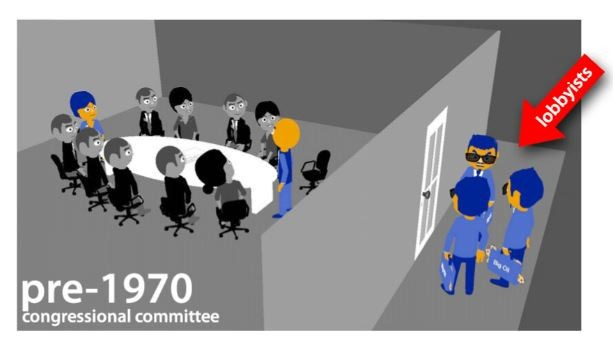
The LRA transformed every vote into a trackable, enforceable data point — and lobbyists exploited it immediately.
The Auto Alliance and Industry Coordination
Representing major manufacturers, the Auto Alliance (now the Alliance for Automotive Innovation) coordinates federal and state regulatory strategy across the industry. Their approach is strategically elegant: advocate for ever-stricter standards that incumbent manufacturers can meet—they have the R&D budgets and existing compliance infrastructure—but that new entrants using expired-patent designs cannot. Each new regulatory layer raises the barrier to entry, not for the incumbents who helped design the regulation, but for potential competitors who would offer affordable alternatives.
This is not speculation about intent. The pattern is visible in the regulatory record itself. When CAFE standards tighten, incumbent manufacturers lobby for phase-in schedules and fleet-averaging provisions that accommodate their existing product lines. A startup seeking to manufacture a 2004 F-150 design (patents expired 2024) receives no such accommodation—it faces the same $150–300 million certification burden from day one, with no existing fleet to average against and no prior compliance relationship with regulators.
Vote-Tracking, Enforcement, and the Agency Backdoor
Senator Bob Packwood, working on the 1986 Tax Reform Act, captured the dynamic precisely: “When we’re in the Sunshine, as soon as we vote, every trade association in the country gets out their mailgrams and their phone calls in 12 hours and complains about the members’ votes. But when we’re in the back room, the Senators can vote their conscience. They vote for what they think is good for the country. Then they can go out to the lobbyists and say: ‘God, I fought for you. I did everything I could.’” However, in public, with votes recorded and lobbyists watching, legislators become performers rather than deliberators.
But lobbyists discovered they didn’t always need to win the congressional vote — they could shape the regulations directly. Harvard political scientist Daniel Carpenter, studying lobbying around the Dodd-Frank Act, found that the regulatory advocacy market directed at federal agencies is so large it eclipses the formal congressional lobbying sector — by his conservative estimate, double or more what is spent on congressional lobbying. This is the industry’s backdoor strategy: even when congressional action fails or stalls, lobbyists cultivate relationships with regulators at EPA, NHTSA, and DOE that shape rulemaking outcomes from within.
These relationships operate through multiple channels. Industry representatives serve on advisory committees that draft proposed rules. Former agency officials join lobbying firms where their regulatory expertise and personal contacts command premium compensation. Current regulators know their future private-sector employment depends on maintaining cooperative relationships with the industries they oversee. The result is a rulemaking process where industry preferences are embedded into regulatory design before public comment periods even begin.
This dynamic explains something otherwise puzzling: why regulations that purportedly serve the public interest so consistently produce outcomes that protect incumbent manufacturers. The answer is not that regulators are corrupt. It is that the revolving door and advisory committee structure ensure industry perspectives dominate the technical details where the real barriers are constructed.
The “Safety” and “Environment” Disguise
The most effective aspect of automotive lobbying is rhetorical: every barrier to expired-patent competition is framed as consumer protection or environmental stewardship. Who could oppose cleaner air? Who would argue against safer vehicles? This framing makes opposition politically toxic—not because the underlying safety and environmental goals are illegitimate, but because the framing obscures the practical effect: blocking competition that would lower prices through expired-patent manufacturing.
The distinction matters constitutionally. Regulations can simultaneously serve legitimate safety purposes and violate the Patent Clause. A rule requiring 2026 emissions compliance for a 2004 expired-patent design may genuinely reduce emissions. It also functionally extends a patent monopoly that the Constitution required to end. Both things are true. The constitutional question is whether agencies possess the authority to achieve the second result, regardless of how beneficial the first result may be.
State-Level Multiplication
California’s CARB standards, adopted by seventeen additional states and the District of Columbia, create a parallel regulatory regime that multiplies compliance barriers beyond the federal level. California’s CARB standards are vehicle emissions rules set by the California Air Resources Board that are stricter than federal EPA requirements. What makes them nationally significant is that other states can choose to adopt California’s rules instead of the federal ones — and about a third of U.S. states have, effectively making California’s standards the de facto national benchmark for automakers. A manufacturer seeking to produce patent-expired vehicles must navigate not only EPA, NHTSA, and DOE requirements but also CARB’s separate emissions certification process—with its own testing protocols, compliance timelines, and administrative procedures.
For incumbent manufacturers, this layered system is manageable: they maintain permanent regulatory affairs departments with established relationships at both federal and state levels. For a would-be manufacturer of expired-patent vehicles, each additional regulatory layer compounds the barrier exponentially. The lobbyists who shaped the federal framework also operate at the state level, using the same vote-tracking leverage to pressure state legislators into adopting standards that further entrench incumbent advantages.
Legislative Capture Through Complexity
Federal legislative volume exploded from approximately 2,000 pages annually before 1970 to over 7,000 pages by 2019. Lobbyists helped draft much of this legislation. As convicted lobbyist Jack Abramoff admitted in a 2011 60 Minutes interview, lobbyists “crafted language that was so obscure, so confusing, so uninformative, but so precise to change the U.S. code.”
The Low Volume Motor Vehicle Manufacturers Act of 2015 exemplifies this technique. On its face, the Act appears to support small-scale manufacturing—permitting up to 325 replica vehicles per year. But it contains a critical poison pill: current emissions compliance remains mandatory, and the 325-unit cap prevents any meaningful competitive impact.
The Act gives the appearance of permitting patent-expired manufacturing while ensuring it can never reach the scale necessary to affect incumbent pricing. This is legislative capture distilled to its essence: the law seems to solve the problem while actually entrenching it.
A Self-Sustaining Financial Model
The financial model powering this ecosystem is self-sustaining and self-reinforcing. Manufacturers pay lobbyists millions annually to maintain regulations that generate hundreds of billions in excess consumer costs. According to OpenSecrets, automotive lobbying expenditures have exceeded $83 million annually since 2023, hitting a record $85.8 million that year. The return on investment is extraordinary: every dollar spent on lobbying protects thousands of dollars in monopoly pricing power.
Campaign contributions complete the circuit. Automotive industry political contributions peaked at $40.5 million in a single election cycle. [22] These contributions flow disproportionately to incumbents who maintain existing regulatory frameworks—and thanks to the vote-tracking mechanisms established after the LRA, lobbyists can verify exactly which legislators earn their investment and which do not.
The ecosystem requires no central coordination and no conspiracy. Each participant—manufacturer, lobbyist, regulator, legislator—acts rationally within the incentive structure to maximize their own benefit. Manufacturers fund lobbying because it protects pricing power. Lobbyists maintain regulations because it justifies their contracts. Regulators cooperate because it ensures future employment. Legislators comply because it secures campaign funding. The constitutional violation—preventing public use of expired patents—is not the goal of any single actor. It is the emergent, self-perpetuating result of a system where every participant’s rational self-interest converges on the same unconstitutional outcome.
Politicians: How the 1970 LRA Turned Constitutional Duty into Campaign Vulnerability
Perhaps the most troubling participants in this system are elected officials who swear an oath to uphold the Constitution yet enable its violation for campaign contributions—not because they’re uniquely corrupt, but because the LRA structurally transformed their incentives, as documented in Sections III-B and III-E.
The Silence is Deafening: Not a single member of Congress has publicly opposed (or recognized) the “hidden war against expired auto patents.” Zero. Out of 535 legislators. This isn’t coincidence—it’s evidence of systematic capture.
The Midterm Calculation: Politicians facing close races need industry support. Challenging the automotive regulatory regime risks losing contributions, negative advertising, and industry opposition. The political cost is immediate; the constitutional violation is abstract.
Dr. Frances Lee’s 2019 Congressional testimony explained the transformation: legislators can no longer “speak candidly with one another without fear that these discussions be used against them, perhaps even out of context, at a later time.”
Many legislators aren’t corrupt or fooled. They’re trapped in a system where the 1970 LRA eliminated the structural protections that once allowed them to resist special interest pressure.
The Revolving Door: Regulatory Capture in Action
The most insidious aspect of this system is the revolving door between industry, regulatory agencies, and lobbying firms. This circulation of personnel ensures regulatory decisions favor incumbent manufacturers while maintaining a veneer of public interest.
Industry to Regulator: An automotive executive or engineer joins EPA or NHTSA in a senior position. They bring industry expertise—and industry perspectives—to regulatory decision-making.
Regulator to Lobbyist: After government service, the same individual joins a lobbying firm representing automotive interests. Their government contacts and regulatory expertise command premium compensation.
Lobbyist to Industry: Eventually, they may return to a manufacturer in a senior regulatory affairs role, completing the circle.
This circulation creates aligned incentives across the ecosystem. Regulators know their future employment depends on maintaining good relationships with industry. Lobbyists know their value derives from regulatory complexity. Industry executives know that cooperative regulators become well-compensated lobbyists. The constitutional violation—preventing public use of expired patents—is the foundation supporting this entire edifice.
J. The $22 Trillion Question: Cui Bono?
When any policy persists despite constitutional invalidity, economic irrationality, and public harm, the right question is: Who benefits?
In this case, the answer is clear-- the five profiteers elaborated in Section III-B.
The only losers are American consumers, who pay $22 trillion more over six decades than they would have if the Patent Clause were honored.
Why Restoration Threatens This Coalition
Understanding the financial stakes explains why restoring constitutional compliance with the Patent Clause faces such fierce resistance. If regulations were revised to allow remanufacturing using patents expired 20+ years ago, every one of the five profiteers would see their income, influence, or political support decline. The trillion-dollar question becomes: Will they defend the Constitution, or their wallets?
History suggests wallets win unless the public mobilizes to demand constitutional compliance.
IV. The Constitutional Promise Works Everywhere It’s Allowed
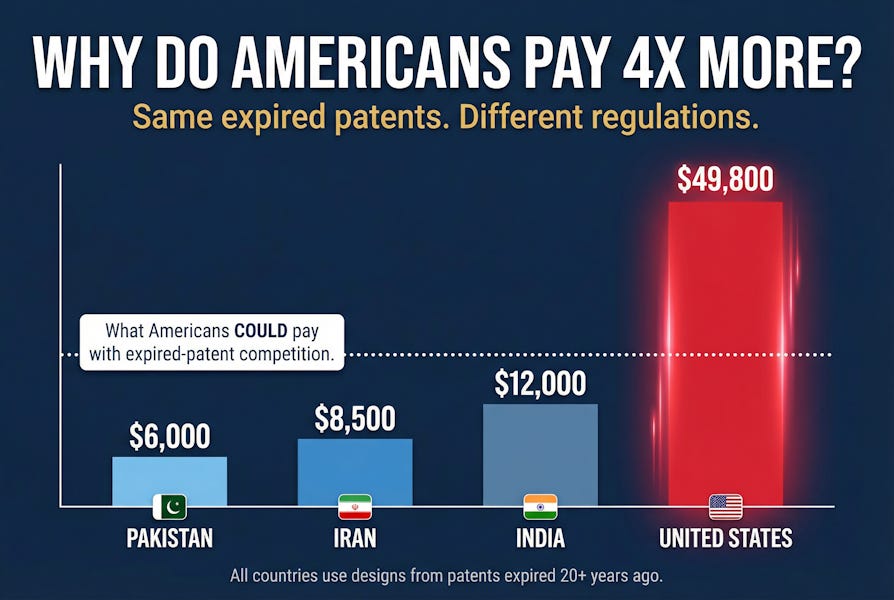
A. International Evidence: Patent-Expired Vehicles at $6,000-$15,000
The constitutional promise is not theoretical. It works in every country that permits patent-expired remanufacturing. The following examples demonstrate the price levels Americans would enjoy if post-1970 regulations did not block expired-patent competition:
India: Mahindra Thar (Jeep CJ clone, design patents expired): $12,000. U.S. equivalent (Jeep Wrangler): $45,000+.
Iran: Peugeot 405 (1987 design, patents expired): $8,500. Comparable U.S. sedan: $25,000+.
Kenya: Proton Saga (Mitsubishi platform, patents expired): $9,000. Comparable U.S. sedan: $22,000+.
Ghana: Kantanka pickup (local assembly, expired patents): $15,000. U.S. compact pickup: $35,000+.
Pakistan: Suzuki Mehran (1980s Alto design): $6,000. U.S. subcompact: $18,000+.
See my article, “Countries with newly remade patent-expired cars and trucks for sale”. You’re able to visit the websites of the dealerships involved in these markets.

These vehicles represent 50-68% savings compared to U.S. equivalents. They are not unsafe death traps—they meet the safety and emissions standards that were acceptable when the designs were current. They are simply older, proven designs manufactured affordably without the cost of meeting ever-escalating regulatory requirements.
American consumers cannot access these options. Not because the designs are patented (they are not). Not because they are unsafe (2004 F-150s remain legal to drive). But because post-1970 regulations prevent their manufacture, protecting incumbent manufacturers from the competition the Constitution promises.
B. The Bicycle: The Patent Clause’s Domestic Transportation Proof
The international evidence above demonstrates that the constitutional promise works wherever regulations permit it. But critics may object that developing-world pricing reflects lower safety standards, not patent expiration. The American bicycle eliminates that objection entirely. According to the Human Progress Institute, the time price of a bicycle has fallen 95.5 percent since 1910, a 2,104 percent increase in personal bicycle abundance.
In 1910, a bicycle cost 66 hours of labor. Today, a comparable bicycle costs roughly three hours. This affordability revolution was driven overwhelmingly by one factor: the sequential expiration of patents. Each time a critical bicycle patent expired, competitors entered the market, improved upon the original design, and drove prices downward while improving quality upward. Today’s $100 department-store bicycle incorporates over 150 years of accumulated patent expirations, from Baron von Drais’s steerable frame (1818) through Shimano’s integrated shifting mechanisms (1990s), all freely available in the public domain.
The effect is not abstract. In 2005, the Trek Madone 5.2, a premium carbon road racing bicycle, sold for $3,400 ($5,400 in 2026 dollars). Today, the SAVA Warwind V3, a UCI-certified full carbon road racing bicycle built entirely from technologies whose patents have expired, sells for $1,099. Same Toray T800 carbon fiber frame, same Shimano componentry, same category of road racing machine. The price difference: 68 percent less in nominal dollars, 80 percent less in inflation-adjusted dollars. Zero active patent royalties are required to manufacture this bicycle. The carbon fiber layup techniques, the derailleur geometry, the rim brake design, the indexed shifting mechanism, and the integrated lever system all derive from patents that expired 20 or more years ago.
This is the constitutional promise made tangible: a $3,400 dream bike from 2005 available today for $1,099, because no federal regulation prevented manufacturers from competing on expired-patent designs. The same dynamic that collapsed calculator prices by 97.5 percent when Texas Instruments’ patents expired (documented in Section III-F above) operates here in a transportation product Americans ride on public roads every day.
The safety evidence is equally decisive, and it directly rebuts the strongest objection to restoring expired-patent competition for automobiles. There are essentially zero federal safety regulations governing the design or construction of the bicycle itself. No federal crash standards, no mandatory anti-lock braking, no airbag requirements, no federal type-approval process.
The only federal requirement is a Consumer Product Safety Commission rule mandating reflectors. Yet the Insurance Institute for Highway Safety, drawing on NHTSA’s Fatality Analysis Reporting System, documents that cyclist deaths among children under 20 fell from 786 in 1975 to 93 in 2023, an 88 percent decline over 48 years achieved entirely through market-driven innovation on expired-patent technology: disc brakes replacing rim brakes, LED lighting replacing incandescent, puncture-resistant tires, lighter and stronger frames. Over the same period, the motor vehicle fatality rate per 100 million vehicle miles traveled declined 62 percent, from 3.35 to 1.26, under thousands of pages of federal safety regulations. The unregulated bicycle achieved a 26-percentage-point greater safety improvement than the heavily regulated automobile. When someone argues that safety regulations justify the cost of blocking expired-patent remanufacturing, the bicycle is the rebuttal: no federal safety regulation, superior safety outcomes, and 95.5 percent lower prices.
The constitutional lesson is unmistakable. No federal regulation prevents anyone from building a bicycle using Dunlop’s tire design, Starley’s frame geometry, or SunTour’s derailleur mechanism. The bicycle followed the constitutional model: patents expired, innovations entered the public domain, competition flourished, and prices fell while safety improved. Automobiles, by contrast, became subject to post-1970 regulatory barriers that prevent this identical process from operating.
Imagine if the federal government had passed regulations requiring all bicycles to meet current-year design standards that only incumbent manufacturers could afford to certify. That hypothetical is precisely what happened with cars.
For the complete historical analysis, including the CAFE-driven replacement of station wagons with high-hood SUVs that made roads lethal for cyclists, and detailed IIHS/FARS fatality data spanning 1975 to 2023, see “How Expired Bicycle Patents Made Two Wheels Affordable & Why Cars Became Less Affordable.”

V. The 1970 Inflection Point: Affordability Before and After Regulatory Capture
The preceding sections established the constitutional framework: the Patent Clause limits monopolies to “limited Times,” post-1970 agency regulations effectively extend those monopolies indefinitely, and a comprehensive institutional silence has kept this violation hidden for over five decades. This section presents the market evidence—what that constitutional usurpation actually did to prices Americans pay.
Vehicle prices relative to median male earnings tell a three-act story, and 1970 is the hinge point.
Act One: Progress (1960–1970). Census Bureau data on male full-time, year-round (FTYR) earnings begins in 1960 (Current Population Reports, P60-37), and the first decade on record is a story of improving affordability. The average new car cost roughly 48% of median male FTYR earnings in 1960 ($2,600 against $5,400), falling to 41.6% by 1970 ($3,542 against $8,517). American automakers were producing better cars at lower relative cost. Competition, manufacturing innovation, and economies of scale were working exactly as market economics predicts—and exactly as the Founders intended when they limited patent monopolies to encourage eventual open competition on expired designs.
Act Two: Reversal (1970–2025). Then came the regulatory explosion. The Clean Air Act Amendments of 1970 authorized EPA emission standards requiring catalytic converters, onboard diagnostics, and progressively tighter controls. The Energy Policy and Conservation Act of 1975 imposed Corporate Average Fuel Economy (CAFE) standards mandating fleet-wide efficiency targets. The Federal Motor Vehicle Safety Standards (FMVSS), expanded throughout the 1970s–1990s, layered hundreds of design requirements—multiple airbags, electronic stability control, backup cameras, and by 2029, automatic emergency braking—onto every vehicle manufactured for initial sale, regardless of whether the underlying design is patent-expired. Each regulation individually may serve legitimate safety or environmental goals. But their cumulative effect created compliance barriers estimated at $50–300 million per vehicle platform—barriers that make it economically impossible for any manufacturer to produce a simple, affordable vehicle based on a 20-year-old expired patent design, no matter how much consumer demand exists.
The result reversed a half-century of progress. By 2025, the average new vehicle transaction price of $49,800 consumes 70.1% of the median male FTYR earnings of $71,090—a 1.68x worsening from 1970. A working man in 1970 could purchase an average new car with five months of gross earnings. His grandson in 2025 needs over eight months.
The pattern holds for individual nameplates. A Ford F-100 base 2WD pickup in 1970 cost just 34.4% of median male earnings; today the same truck—now the F-150 XL base 2WD at $38,565—costs 54.3%, a 1.58x worsening. The F-Series has been America’s best-selling vehicle since 1981 and the longest continuously produced truck nameplate in the country—making it the cleanest possible apples-to-apples comparison across the 1970 regulatory divide.
Act Three: Extinction. But the most damning evidence is not rising prices. It is the disappearance of entire product categories.
The affordable full-size American sedans that dominated the 1970 new-car market—the Chevrolet Impala, Ford Galaxie 500, and Plymouth Fury—have not merely become more expensive. They have been eliminated entirely. The Galaxie was discontinued in 1974, the Fury in 1978, the entire Plymouth brand in 2001, the Crown Victoria in 2011, the Taurus in 2019, the Fusion in 2020, and the Impala in 2020. Ford Motor Company today sells zero passenger sedans in the United States. The three best-selling passenger cars of 1970—affordable, full-size family sedans purchasable for roughly 35–40% of a working man’s annual earnings—do not exist at any price in 2025.
This is not a story about consumer preferences shifting to trucks and SUVs. Consumer preferences shifted because post-1970 regulatory compliance costs made it unprofitable to manufacture affordable sedans. When federal mandates add tens of thousands of dollars to every vehicle platform, manufacturers rationally abandon low-margin vehicles and concentrate on high-margin trucks and SUVs that can absorb the compliance costs. The regulations did not follow the market—they reshaped it.
The affordable American family car did not price itself out of the market. Post-1970 federal regulations priced it out of existence.
Section VI quantifies the cumulative national cost of this regulatory displacement.
VI. The $22 Trillion Wealth Transfer: Conservative Estimate of Constitutional Theft
A. Methodology: How the $22 Trillion Figure Was Calculated
The $22 trillion estimate represents the average of two independent AI-assisted calculations analyzing cumulative consumer overpayment from 1970-2025 across all sectors affected by post-1970 regulatory barriers to expired-patent remanufacturing.
Grok 4.1 calculated $28 trillion based on Bureau of Economic Analysis data for motor vehicles, household durables, recreational vehicles, and nonresidential equipment. Claude Sonnet 4.5 calculated $15.73 trillion using more conservative assumptions, explicitly noting this represents “the floor, not the ceiling.”
Calculations and data sources for the $22 trillion figure are in my article, “The $22 Trillion Constitutional Theft--How Energy & Safety Laws Created Perpetual Patents”.

Both calculations used:
1. Base spending data from Federal Reserve Economic Data (FRED) via BEA quarterly series, converted to annual, with 2025 extrapolated at 4% real growth from 2024 actuals.
2. Realistic savings rates of 25-40% derived from international patent-expired pricing data, accounting for budget buyers shifting to remakes (40-60% cheaper), mid-tier models discounting 10-20% to compete, and premium buyers still paying for latest features.
3. Present value conversion to 2025 dollars using CPI adjustment.
The 25–40% savings rate is grounded in the international pricing evidence documented in Section IV-A. Patent-expired vehicles in India sell for 73% less than U.S. equivalents ($12,000 vs. $45,000), in Iran 66% less ($8,500 vs. $25,000), in Pakistan 67% less ($6,000 vs. $18,000), and in Kenya 59% less ($15,000 vs. $35,000). Raw international savings thus range from 59–73%.
However, not all U.S. consumers would switch to patent-expired remakes. The analysis models three buyer tiers: budget buyers (approximately 40% of the market) shifting to remakes at 40–60% savings; mid-tier buyers (approximately 35%) benefiting from 10–20% competitive discounting as manufacturers lower prices to retain customers; and premium buyers (approximately 25%) continuing to purchase current-year vehicles at existing prices.
Blending these tiers produces the 25–40% aggregate market savings rate used in both calculations. This is deliberately conservative — it assumes patent-expired competition disciplines pricing across the entire market (as it did with calculators and generic pharmaceuticals) while acknowledging that a substantial share of buyers would still choose newer models.
The $22 trillion midpoint is conservative. It excludes:
· Compounding economic effects (reduced business formation, lost innovation, diminished entrepreneurship)
· Indirect costs (higher housing, food, transportation costs rippling through the economy)
· Many specialized equipment categories (mining, oil & gas, semiconductor manufacturing, pharmaceutical production)
· The “innovation tax” (products never developed due to regulatory barriers)
B. Per-Household Impact: $121,000 Over 50 Years
The $22 trillion aggregate translates to $314.6 billion annually, or $3,385 per household per year.[23] Over fifty years (1975-2025), the average American household has paid approximately $121,000 in excess costs for vehicles, appliances, equipment, and services that could have been provided far more affordably using patent-expired designs.
This is not money spent on genuine safety improvements or innovation. It is the cost of regulatory compliance that serves primarily to eliminate competition from patent-expired alternatives.
C. Why This is Properly Characterized as “Theft”
The Constitution promises that after twenty years, patent-protected inventions pass to the public and become free for all to use. In Kimble v. Marvel Entertainment, 576 U.S. 446 (2015), the Court confirmed that upon expiration, the unrestricted right to make or use the article passes to the public. Graham v. John Deere Co., 383 U.S. 1 (1966), went further, holding that Congress itself may not remove existing knowledge from the public domain.
When federal regulations render that right economically unusable across whole product classes, the Fifth Amendment’s Takings Clause provides independent grounds for relief alongside the Patent Clause theory. Patents are property for Takings Clause purposes — a proposition reaching back 144 years to James v. Campbell, 104 U.S. 356 (1882), and reaffirmed through McCormick Harvesting (1898) and Florida Prepaid (1999). Most directly on point is Ruckelshaus v. Monsanto, 467 U.S. 986 (1984), where the Court held that EPA’s handling of trade-secret data under FIFRA was a Fifth Amendment taking — foreclosing any argument that intangible, IP-type property falls outside Takings Clause protection.
The individual would-be remanufacturer, restorer, or consumer holds the property interest: the legally cognizable liberty to practice a specific expired invention, which post-1970 regulatory structures take. Under Penn Central (1978), all three factors favor the plaintiff; where the economic wipeout is complete, Lucas v. South Carolina Coastal Council, 505 U.S. 1003 (1992), supplies a categorical per se rule. The Roberts Court’s trajectory in Horne (2015), Cedar Point Nursery (2021), and Tyler v. Hennepin County (2023) runs toward broader, not narrower, property protection.
The $22 trillion did not disappear. It was transferred from American households to incumbent manufacturers who should have faced competition but did not, because agencies prevented that competition through regulatory barriers never explicitly authorized by Congress and never subjected to constitutional scrutiny.
For more on this, see “Why the Takings Clause Provides a Second Path (Alternative Theory)” in a subsequent published article.
VII. Standing, Justiciability, and Multiple Litigation Pathways
A. Who Has Standing to Challenge These Regulations?
Standing requires (1) injury-in-fact, (2) causation, and (3) redressability (that is, can a court actually fix the problem). Multiple potential plaintiffs satisfy these requirements:
1. State Attorneys General and Governors: States are entitled to ‘special solicitude’ in standing analysis and may sue the federal government to assert their own sovereign and quasi-sovereign interests, including direct economic injuries to state economies from unconstitutional regulatory barriers.[24] States suffer concrete injury: residents pay inflated prices, tax revenues decline due to reduced economic activity, and state purchasing budgets face higher costs for vehicles and equipment.
2. County and Municipal Governments: Local governments suffer direct fiscal injury through inflated procurement costs for vehicles, equipment, and supplies whose prices reflect regulatory barriers blocking expired-patent competition.[25]
3. Sheriffs. Among the most powerful yet overlooked plaintiffs are the nation’s 3,081 county sheriffs. Every sheriff’s department purchases vehicles, equipment, and medical supplies at prices inflated by regulatory barriers that block expired-patent competition. A county that pays $55,000 per patrol vehicle instead of $25,000, or overpays for generic medications in its jail pharmacy, suffers a concrete fiscal injury traceable directly to these post-1970 regulatory frameworks. When a county governing body formally authorizes its sheriff to bring suit on the county’s behalf, the challenge combines the institutional standing of an injured government entity with the public credibility of an elected law enforcement official accountable directly to voters — precisely the structure that carried Printz v. United States from rural Ravalli County, Montana to the Supreme Court. With 3,081 sheriffs serving in counties across all fifty states, the potential for coordinated constitutional challenges is enormous — and unlike federal appointees, sheriffs answer to their communities, not to Washington.[25]
4. Would-Be Manufacturers: Any entity seeking to remanufacture patent-expired designs but prevented by regulatory compliance costs has direct, concrete injury.
The regulatory barriers blocking remanufacture of expired-patent designs are so prohibitive that no domestic manufacturer has even attempted to enter these markets — itself powerful evidence of the constitutional harm. Compliance costs of $50-300 million per automotive platform and multi-year FDA approval processes have created what courts recognize as a chilling effect on constitutionally protected activity. This is precisely why consumer, county government, and state attorneys general plaintiffs are essential — the very entities who would have standing as manufacturers have been regulated out of existence before they could form.
5. Individual Consumers: Every American household suffers concrete, quantifiable injury from the absence of expired-patent competition — paying an average of $49,800 for vehicles that competitive markets would price near $25,000, and comparable premiums across pharmaceuticals, medical devices, and household goods. These injuries are directly traceable to regulatory compliance barriers that prevent market entry by competing manufacturers of 20-year-old expired patent designs, and are redressable through declaratory judgment that such barriers violate the Patent Clause or injunctive relief removing them. The scale of injury — affecting every household in every congressional district — makes consumer class actions a particularly powerful vehicle for constitutional challenge.
A. Justiciability: Why This Is Not a Political Question
The political question doctrine bars judicial review when issues are constitutionally committed to another branch or lack judicially manageable standards. Neither barrier applies here:
1. The Patent Clause is a judicially enforceable constitutional limitation. Courts routinely review whether patents comply with the “limited Times” requirement. This case merely extends that review to ask whether regulatory barriers functionally extend patents beyond their limited term.
2. Judicially manageable standards exist: Does the regulation make it economically impossible to manufacture patent-expired designs? If yes, does it violate the Patent Clause? Courts apply similar tests in Takings Clause cases (total deprivation of economic use) and Major Questions Doctrine cases (clear congressional authorization).
3. The question is legal, not policy: Not whether regulations promote safety or environmental protection (policy question), but whether agencies possess constitutional authority to impose them in a manner that extends patent monopolies (legal question).
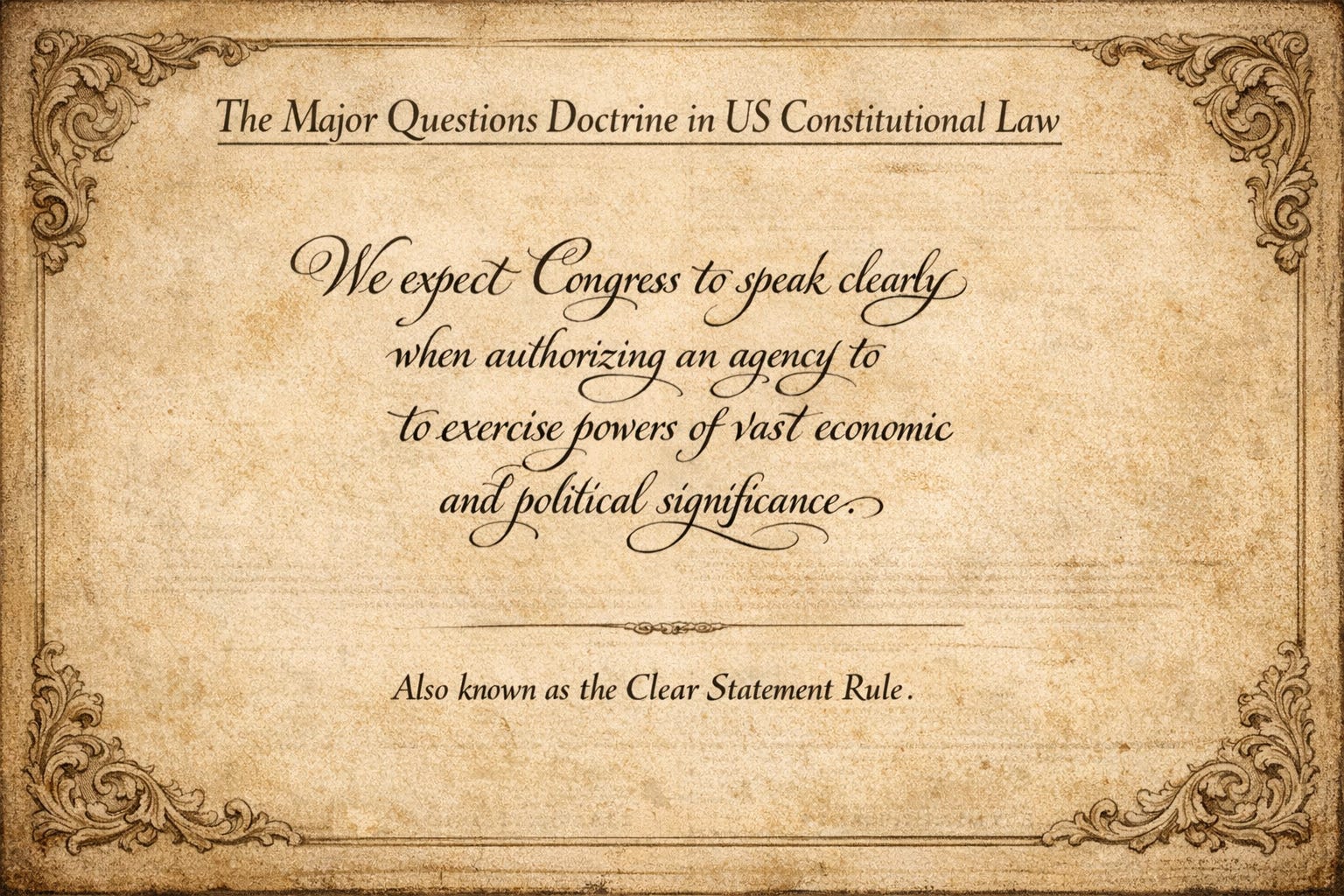
A. Multiple Litigation Pathways: Patent Clause, Takings, and Major Questions
Plaintiffs can pursue multiple theories simultaneously—standard practice in complex constitutional litigation:
Primary Theory: Patent Clause Structural Violation. Post-1970 regulations violate the Patent Clause by functionally extending monopolies beyond “limited Times” without congressional authorization, triggering heightened scrutiny under the Major Questions Doctrine.
Alternative Theory: Regulatory Takings. Under Arkansas Game & Fish Commission v. United States and Cedar Point Nursery v. Hassid, cumulative regulatory impacts can constitute takings when they deprive property of use. The public’s constitutional entitlement to expired patents is a cognizable property interest. Regulations rendering that interest economically valueless may require compensation.
Procedural Challenge: Major Questions Doctrine. Even if regulations do not violate the Patent Clause directly, agencies must demonstrate clear congressional authorization for rules of vast economic significance that functionally eliminate public access to expired patents. West Virginia v. EPA and Loper Bright Enterprises v. Raimondo require this showing.
These theories are complementary, not contradictory. Litigation teams can develop each simultaneously, presenting courts with multiple independent grounds for relief.
VIII. Remedies: Restoring the Constitutional Promise
A. Declaratory Relief: Require Patent Clause Analysis in Rulemaking
Courts could issue declaratory judgments requiring EPA, NHTSA, and DOE to conduct Patent Clause impact analysis when promulgating regulations affecting sectors with expired patents. This would not dismantle safety or environmental protection—it would require agencies to demonstrate that compliance burdens do not functionally extend patent monopolies or, if they do, that Congress explicitly authorized such extension.
B. Injunctive Relief: Grandfather Patent-Expired Designs
Courts could enjoin agencies from applying current-year standards to products whose design patents expired more than twenty years ago. Manufacturers remanufacturing exact copies of designs approved twenty years prior would face reasonable verification burdens (proving exact compliance with original specifications) but would not be required to meet current-year standards.
Consumers would receive clear labeling: “This vehicle meets 2004 safety and emissions standards.” The constitutional promise would be restored.
The Constitutional Distinction from Classic Car Exemptions
Federal law already permits what the Patent Clause constitutionally requires — the manufacture of vehicles based on older designs without full modern regulatory compliance. Under 49 U.S.C. § 30112(b)(9), vehicles at least 25 years old are completely exempt from Federal Motor Vehicle Safety Standards. The EPA similarly exempts vehicles 21 years or older from Clean Air Act emissions requirements. Most significantly, under 49 U.S.C. § 30114(b), Congress authorized low-volume manufacturers to produce up to 325 new replica vehicles per year exempt from FMVSS — establishing that Congress itself recognizes the feasibility of manufacturing older designs without imposing the $50–300 million per-platform compliance costs that currently block market entry.[26]
This distinction matters legally and constitutionally. Classic car exemptions and the replica vehicle program are discretionary policy choices — regulators could eliminate them tomorrow without constitutional consequence. But the Patent Clause is not discretionary. The Supreme Court’s holding that expired-patent designs pass to the public “free from all restriction” means regulatory barriers blocking their manufacture are not merely bad policy — they are structural constitutional violations. The Constitution demands what these statutes merely permit, and it demands it for every expired patent, not just 325 replicas per year.
Independent Certification Ensures Safety Without Blocking Competition
Just as classic car imports require documentation proving authenticity and age (to prevent modern vehicles from claiming antique status fraudulently), patent-expired manufacturing should require independent engineering certification that vehicles are authentic remakes of patent-expired designs—not modern designs masquerading as patent-expired to evade regulations.
This certification framework already exists under the Low Volume Motor Vehicle Manufacturers Act, which requires replica manufacturers to certify their vehicles replicate designs 25+ years old. The infrastructure is proven. The administrative burden is modest. The safety protection is real.
The difference: LVMVA still requires current emissions compliance (defeating the affordability purpose) and caps production at 325 vehicles annually (preventing meaningful competition). A patent-expiration exemption would remove both restrictions for designs whose patents expired 20+ years ago, while maintaining independent certification to ensure authenticity.
Precedent Is Established, Framework Is Proven
The regulatory infrastructure for age-based exemptions already exists across federal and state governments. Extending it to patent-expired manufacturing is a modest administrative adjustment, not a radical regulatory overhaul. EPA, NHTSA, and state DMVs already process classic car exemptions. They can process patent-expiration certifications using the same bureaucratic machinery.
The precedent is established. The framework is proven. The constitutional imperative is clear. Classic car exemptions demonstrate that older designs can coexist with modern regulations without safety catastrophes or environmental collapse. Patent-expired exemptions simply extend that proven principle to manufacturing, not just driving—and do so under constitutional mandate, not regulatory discretion.
Notably, classic car exemptions apply to vehicles from an era with significantly worse safety records—pre-airbag, pre-ABS, pre-crumple zones—yet remain politically uncontroversial and create no measurable safety crisis. Patent-expired exemptions would apply to 1995–2005 designs that already include airbags, ABS, electronic stability control, and modern crumple zones. If a 1965 Mustang without any of these features can legally drive on American roads today, objecting to manufacturing a 1995 F-150 with all of them is transparently about protecting monopoly pricing, not public safety.
C. Executive Action: Patent-Expired Remanufacturing Exemption
The President could direct agencies to create a “Patent-Expired Remanufacturing” exemption, allowing products meeting the standards in effect when design patents were granted (minimum twenty years ago) to be remanufactured and sold with appropriate consumer disclosure.
I got SuperGrok to write a short science fiction novel where the President does just this. See my article, “The 2026 mid-terms where Trump wins a filibuster-proof Senate - the EO behind it – a lookback.” Whoever the President is in the future when reading this article could do such.

This requires no legislation. It merely aligns regulatory practice with constitutional requirements.
D. Legislation: Patent Expiration Integrity Act
Congress could pass legislation clarifying that expired patents may be remanufactured to original specifications meeting standards from twenty years prior, with appropriate consumer disclosure and verification requirements. This would codify the constitutional promise rather than leaving it to agency discretion.
E. Compensation: Takings Clause Remedy
If courts determine that regulations constitute an uncompensated taking of public domain rights, the remedy is compensation for the $22 trillion wealth transfer (or whatever amount the Court determines is supported by evidence). This would come from the Treasury, not directly from manufacturers, though manufacturers would lose their regulatory protection going forward.
IX. The Structural Fix: Constitutional Hybrid Voting
Even if today’s regulations are defeated through judicial challenge, executive action, or public mobilization, lobbyists will simply push new barriers through a captured Congress unless the 1970 LRA’s transparency provisions are revised to restore legislative independence.
As established in Section III-B, the LRA’s recorded votes and open committee proceedings empower lobbyists, not citizens. The regulatory exemptions proposed in Part VIII would restore the Patent Clause’s promise. But without structural reform to Congress itself, the same lobbying apparatus that created the current barriers will engineer new ones. Part VIII is the cure. This Part is the vaccine.
A. The Constitutional Basis for Legislative Secrecy
A constitutional remedy exists: Hybrid Voting.
This approach combines modern public voting transparency with constitutionally-protected legislative secrecy to break lobbyist control. The Constitution explicitly permits it. Article I, Section 5, Clause 3 states: “Each House shall keep a Journal of its Proceedings, and from time to time publish the same, excepting such Parts as may in their Judgment require Secrecy.” The Framers understood that external pressure—whether from mobs, monarchs, or monied interests—undermines deliberative governance. They designed legislative secrecy into the constitutional structure precisely to protect legislators’ independence.
This isn’t radical innovation—it’s constitutional restoration. Aristotle designed secret ballot machines for Greek legislators 2,400 years ago to prevent vote-buying and coercion. See my article “What is Aristotle’s secret ballot machine for legislators? Reasons for DOGE & Trump to use it”.

For 180 years, Congress reduced the national debt 80 times while operating with significant procedural privacy. Congress has not reduced the debt even once, after 1957, per the US Fiscal Treasury historical debt dataset.
B. How Hybrid Voting Works
The framework is straightforward:
When a scheduled floor bill fails to achieve 50%+1 in the initial public vote, the House or Senate conducts a second vote using legislative secret voting. This secret ballot allows legislators who fear retribution from their public vote—whether from lobbyists, party leadership, major donors, or primary challengers—to vote their conscience without recorded accountability to special interests.
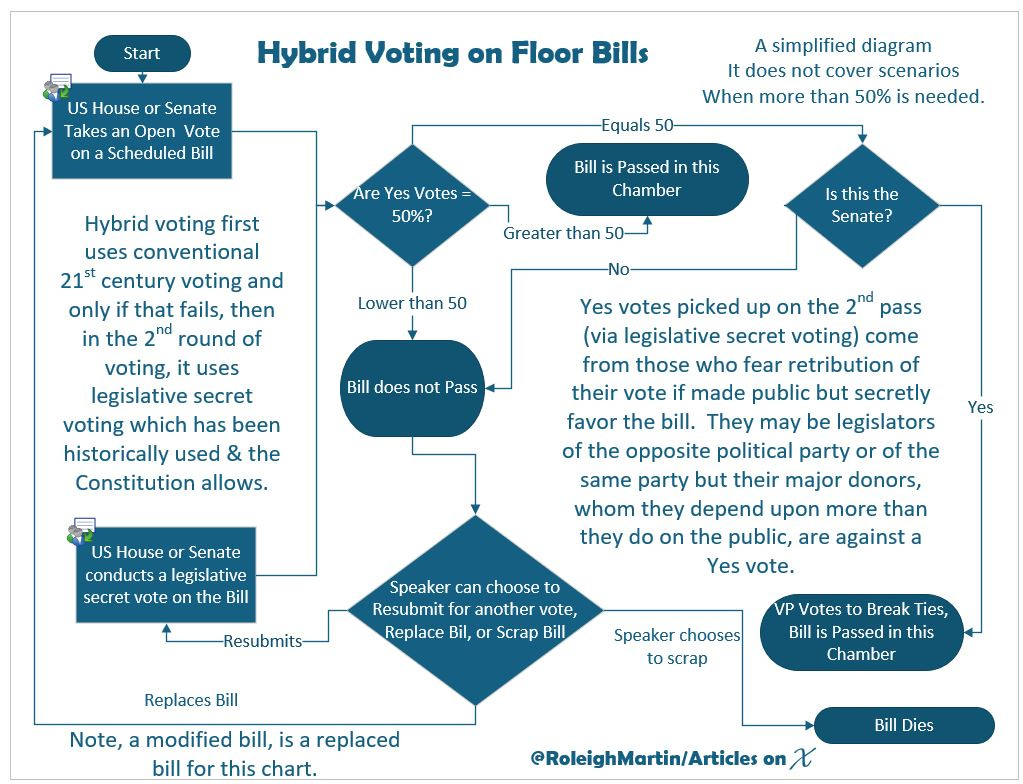
The mechanics are simple: If the initial public vote fails, legislators who privately support the measure but fear public retribution can provide the votes needed for passage in the secret second round. The final tally (total yes/no counts) is published, but individual vote attribution remains unknown and unprovable. Lobbyists cannot punish legislators for votes they cannot verify. Campaign contributors cannot condition funding on voting records that don’t exist.
C. Historical Precedent: Pre-1970 Voting Methods
Prior to 1970, legislators had many legislative voting methods that shielded them from external pressure and retribution. I reviewed the array of methods used in the past in my article, “The History of Secret Legislative Voting in the US Congress.”
Legislators could employ various voting methods, including voice votes, where the presiding officer gauges the outcome based on the volume of “Ayes” or “Noes” without noting individual names, or secret ballots, using paper ballots, colored cards, tally cards, or tokens to allow anonymous voting with results tallied without identifying voters. Roll-call votes required each legislator to publicly state “yea” or “nay” as their name was called, recording votes openly, while division votes had members stand or raise hands to indicate their stance, often for treaties, noting outcomes but not always individual identities. Unanimous consent allowed measures to pass without a formal vote if no senator objected, relying on implicit agreement.
Of the numerous ways Congress conducted meetings and did legislative votes, it’s difficult to determine definitively what worked best. As proposed in Section III-C, digitizing the complete Congressional voting record since 1789 — a $25 million project with $1.5 million in annual maintenance — would enable definitive analysis of which historical methods best protected legislative independence.
D. International Precedent: Italy’s Voto Segreto
Italy’s Voto Segreto precedent demonstrates viability: for 119 years, Italian Parliament used secret voting on floor amendments, successfully passing controversial measures (like legalizing divorce in 1970) that would have failed under lobbyist pressure in public votes. The system was only eliminated in 1988—and Italy’s subsequent governance failures mirror America’s post-1970 dysfunction. See my article, “How Another Legislature Avoided Coercion for 74 Years

Hybrid Voting, Aristotle’s legislative voting process, and Italy’s Voto Segreto are all delved in deeply in this Article of mine, “What is Hybrid Legislative Voting – Why D.O.G.E. needs it to help reduce the national debt”.

E. Why Hybrid Voting Is Essential to Restoring the Patent Clause
Hybrid Voting preserves transparency as the default while restoring the protective secrecy that enables legislators to resist trillion-dollar lobbying pressure. It is the structural reform necessary to make regulatory rollback sustainable—without it, any victory against current regulations will simply be followed by new barriers lobbied through a still-captured Congress. With Hybrid Voting, legislators gain the freedom to say yes to constitutional compliance without political suicide.
Implementing Hybrid Voting would give legislators the structural protection necessary to vote for constitutional compliance over campaign contributions, for consumer welfare over lobbyist demands, for fiscal responsibility over special interest spending. It would make the “back room” where senators can vote their conscience constitutionally accessible again—not as corruption’s breeding ground, but as democracy’s protective mechanism against external coercion.
This recommendation will seem radical to those who believe transparency ensures accountability. But the evidence is overwhelming: post-LRA transparency has destroyed accountability by making legislators accountable to lobbyists with vote-tracking scorecards rather than to constituents with diffuse interests.
The Founding Fathers understood this. They drafted the Constitution in secret. They wrote legislative privacy into the constitutional structure. They knew that external pressure—whether from mobs, monarchs, or special interests—undermines deliberative governance.
The 1970 LRA abandoned that wisdom in pursuit of “sunlight” that would supposedly disinfect corruption. Instead, as the Congressional Research Institute documented, it created a system where “endless sunshine kills what it is meant to nourish.”
X. Conclusion
The Constitution promised that patent monopolies would exist for “limited Times” and that, upon expiration, inventions would enter the public domain for everyone’s benefit. As this Article has demonstrated, post-1970 regulatory regimes have systematically nullified that promise — achieving through compliance barriers what the Constitution explicitly forbids. The evidence is overwhelming: international markets prove the constitutional promise works wherever it is allowed (Section IV); the calculator industry proves it works whenever agencies cannot block it (Section IV-B); and domestic price history proves the 1970 regulatory inflection point destroyed a half-century of improving affordability (Section V). The estimated cost to American families: $22 trillion over five decades (Section VI).
The comprehensive institutional silence documented in Section III — zero congressional hearings, zero investigative journalism, zero academic scholarship — is not coincidence. It is the predictable result of a system where every institution with the power to expose the violation profits from its continuation. But rational incentives do not make constitutional violations lawful.
The path forward is clear.
Restoring the Patent Clause to its intended function requires confronting this trillion-dollar coalition at two levels:
First, the Regulations Need a Constitutional Exemption, Not Elimination: The immediate remedy is not to repeal EPA emissions standards, NHTSA safety requirements, or DOE fuel economy mandates for modern vehicles. These regulations serve legitimate purposes for new designs and never-patented vehicles. The constitutional violation occurs when these same regulations prevent manufacturing using patent-expired designs—blocking the public’s “unrestricted right” promised by the Patent Clause.
The remedy is a grandfather exemption for patent-expired designs. Just as classic car exemptions recognize that 1960s vehicles cannot comply with 2025 emissions standards, a patent-expiration exemption would recognize that designs whose patents expired 20+ years ago cannot—and constitutionally should not need to—comply with current regulatory requirements enacted after the patents expired.
The framework is straightforward: Any vehicle design whose core patents have been expired for 20+ years can be remanufactured to the original specifications, provided independent engineering certification verifies it is an authentic remake of the patent-expired design. This certification—similar to requirements for replica vehicles under the Low Volume Motor Vehicle Manufacturers Act—ensures vehicles are not safety hazards masquerading as patent-expired remakes.
As detailed in Part VIII, federal law already permits manufacturing older designs through classic car exemptions and the LVMVA replica program—proving the administrative framework exists and functions without safety catastrophe. The constitutional difference is that the Patent Clause demands what those statutes merely permit, and demands it for every expired patent, not just 325 replicas per year.[26]
This approach could be achieved through:
· Executive action: Presidential executive order directing EPA, NHTSA, and DOE to create patent-expiration exemptions through regulatory rulemaking, or enforcement discretion declining to prosecute patent-expired manufacturing
· Legislative reform: Congressional revision of Clean Air Act, CAFE standards, and FMVSS regulations to explicitly exempt vehicles manufactured from designs whose patents expired 20+ years ago, with independent certification requirements
· Judicial action: Patent Clause litigation establishing that post-patent-expiration regulations violate the constitutional guarantee of public domain access, or regulatory takings claims under Tyler v. Hennepin County and Sheetz v. County of El Dorado precedents
The regulations stay. The constitutional violation ends. Modern vehicles continue meeting current standards. Patent-expired designs become manufacturable again—exactly as the Founding Fathers intended when they wrote “limited Times” into the Constitution.
A constitutional court challenge can bring this issue to a strong judicial and public light. Any of the 50 state governors, 50 state attorneys general, and even any of the 3081 county sheriffs can create a court case of the taking directly affecting their state or county.
Second, the Structural Problem Must Be Fixed—Through Constitutional Hybrid Voting:
Sustaining the reform advocated above under the “First” recommendation, requires liberating Congress from the lobbyist capture documented throughout this Article. Part IX proposes Constitutional Hybrid Voting — the structural fix that breaks the 1970 LRA’s enforcement mechanism and gives legislators the freedom to vote for constitutional compliance without political suicide.
In 1906, Upton Sinclair exposed meatpacking conditions. In 1902, Ida Tarbell exposed Standard Oil. In 1904, Lincoln Steffens exposed municipal corruption. In each case, public awareness generated unstoppable pressure for change.
This Article provides that awareness for the post-1970 regulatory regime. The question is not whether the constitutional violation exists—the Supreme Court’s precedents make that clear. The question is whether Americans, once informed, will tolerate $121,000 per household stolen to protect manufacturers from the constitutional promise of patent expiration.
The post-1970 regulatory regime that nullifies the Patent Clause can end the same way meatpacking conditions and the Standard Oil monopoly ended: once enough people know the truth.
End Notes
1. The $22 Trillion Regulatory Taking Estimate. See Section VI-A for full methodology, assumptions, and data sources. Detailed calculations and source data also available in “The $22 Trillion Constitutional Theft — How Energy & Safety Laws Created Perpetual Patents”.
2. Regulatory Compliance Cost Estimate:
National Research Council, “Cost, Effectiveness, and Deployment of Fuel Economy Technologies for Light-Duty Vehicles” (Washington, DC: National Academies Press, 2016). Estimates CAFE and emissions standards add $1,500-$3,000 per vehicle in compliance costs.
Center for Automotive Research, “The Impact of Federal Motor Vehicle Safety Standards on the U.S. Automotive Industry” (2021). Documents that mandatory safety features (airbags, ABS, stability control) add $1,500-$2,500 per vehicle.
NHTSA, “Federal Motor Vehicle Safety Standards; Automatic Emergency Braking Systems for Light Vehicles,” 88 Fed. Reg. 11798 (proposed rule Feb. 27, 2023). Estimates automatic emergency braking requirement adds $1,000-$2,000 per vehicle cost.
3. Automotive manufacturers spent an estimated $20.8 billion on U.S. advertising in 2023. Statista, “Automotive Advertising Spending in the United States from 2021 to 2023,” https://www.statista.com/statistics/497358/automotive-ad-spend-usa/. This figure covers manufacturer (Tier 1) advertising only. U.S. auto dealers separately spent $9.22 billion on advertising in 2024, with the typical new car dealership spending $543,539 annually. National Automobile Dealers Association, 2024 Annual Report, as reported in InsideRadio (April 7, 2025), https://www.insideradio.com/free/auto-dealer-ad-spending-rises-but-tariffs-could-stall-progress/article_50220b23-6918-45d0-8325-ea84cc822a85.html. Total automotive industry advertising — combining manufacturers, dealers, parts suppliers, and auto websites — exceeds $30 billion annually, representing one of the largest single-industry advertising categories in the United States.
4. The 1.58x affordability worsening is calculated using a ratio-of-ratios method comparing vehicle price as a share of median male full-time, year-round (FTYR) worker earnings in 1970 versus 2025. In 1970, the Ford F-100 base 2WD MSRP of $2,931 represented 34.4% of the median male FTYR earnings of $8,517. In 2025, the Ford F-150 XL base 2WD MSRP of $38,565 represents 54.3% of the median male FTYR earnings of $71,090. Dividing 0.543 by 0.344 yields 1.58 — meaning a comparable base pickup truck now consumes 58% more of a working man’s annual income than it did in 1970. The F-100/F-150 comparison is particularly instructive because the Ford F-Series is the longest continuously produced truck nameplate in American history and has been America’s best-selling vehicle since 1981, providing a consistent benchmark across 55 years.
The broader new-vehicle market tells an even starker story. In 1970, the average new car transaction price of $3,542 represented 41.6% of median male FTYR earnings. In 2025, the average new vehicle transaction price of approximately $49,800 (per Kelley Blue Book/Cox Automotive) represents 70.1% of median male FTYR earnings — a 1.68x worsening. But even this figure understates the affordability crisis, because the product categories available to working families have fundamentally changed. In 1970, the three best-selling passenger cars in America were the Chevrolet Impala, the Ford Galaxie 500, and the Plymouth Fury — affordable, full-size family sedans that a median-income working man could purchase for roughly 35–40% of his annual earnings. Today, none of these vehicles exist at any price. The Galaxie 500 was discontinued in 1974, the Plymouth Fury in 1978, the entire Plymouth brand in 2001, the Ford Crown Victoria in 2011, the Ford Taurus in 2019, the Ford Fusion in 2020, and the Chevrolet Impala in 2020. As of 2025, Ford Motor Company sells zero passenger sedans in the United States market. The affordable American full-size family sedan — the vehicle that defined the mainstream new-car market in 1970 — has been eliminated entirely from domestic production.
The cumulative effect of post-1970 federal safety mandates, emissions standards, Corporate Average Fuel Economy (CAFE) requirements, and crash-testing regimes has not merely increased the cost of new vehicles; it has made it economically impossible to manufacture and sell the kind of simple, affordable automobile that the median American worker could once readily afford. The 1970 and 2025 male FTYR median earnings figures are from the U.S. Census Bureau, Current Population Reports P60 series, Table A-7, in Melissa Kollar and Zach Scherer, Income in the United States: 2024, P60-286 (September 2025), https://www.census.gov/library/publications/2025/demo/p60-286.html.
The 1970 Ford F-100 base 2WD price of $2,931 is documented in an original factory window sticker archived at Fordification.com. The 2025 Ford F-150 XL 2WD base MSRP of $38,565 is from Ford Motor Company, https://www.ford.com/trucks/f-150/. The 1970 average new car transaction price of $3,542 is from multiple historical sources including the National Automobile Dealers Association. The 2025 average transaction price is from Cox Automotive/Kelley Blue Book, November 2025.
5. Post-1970 Automotive Regulatory Regime Clean Air Act Amendments (1970, 1977, 1990): Established EPA emission standards requiring catalytic converters, onboard diagnostics, and progressive tightening. 42 U.S.C. §§ 7401-7671q.
Corporate Average Fuel Economy (CAFE) Standards (1975): Energy Policy and Conservation Act, Pub. L. 94-163, 89 Stat. 871, codified at 49 U.S.C. § 32902. Mandates fleet-average fuel economy targets requiring advanced technologies often tied to recent patents.
Federal Motor Vehicle Safety Standards (FMVSS): National Highway Traffic Safety Administration (NHTSA) standards expanded significantly post-1970. See 49 C.F.R. Part 571. Requirements include multiple airbags, electronic stability control, backup cameras, and (by 2029) automatic emergency braking.
6. Department of Energy Appliance Efficiency Standards: National Energy Conservation Policy Act of 1978, Pub. L. 95-619, 92 Stat. 3206, as amended by the National Appliance Energy Conservation Act of 1987, Pub. L. 100-12, 101 Stat. 103, codified at 42 U.S.C. § 6295 et seq. DOE sets minimum energy efficiency standards for “new” consumer products including refrigerators, air conditioners, water heaters, and furnaces. Like automotive regulations, these standards apply to any product manufactured for initial sale regardless of whether the underlying design is patent-expired, effectively prohibiting remanufacture of older, simpler designs that consumers could otherwise purchase at substantially lower cost.
7. FDA, Generic Competition and Drug Prices: New Evidence Linking Greater Generic Competition and Lower Generic Drug Prices (Dec. 2019), available at https://www.fda.gov/about-fda/center-drug-evaluation-and-research-cder/generic-competition-and-drug-prices (documenting generic price reductions of 79–95% with four to six or more competitors).
8. Congressional hearing search via Congress.gov, 1970-2025 (zero results for “patent expiration” + “regulatory barriers”) found nothing. No one in the Congressional Record appears to have directly raised concerns about federal regulations effectively violating the “Limited Times” clause by preventing the remanufacture of entire patent-expired vehicles. The question I asked Claude Sonnet, GPT, Grok and Llama came up with nothing when asked “In regards to being able to remanufacture a patent-expired vehicle (car or truck), in the Congressional record, has anyone spoke up or written about regulations affecting the “Limited Times” clause in Article 1, Section 8, Clause 8 of the Constitution (the Patent Clause)?” One exception noted, Meta.AI did refer to my post here on Facebook as relevant.
9. LexisNexis news search, major outlets 1970-2025.
10. GAO Reports database search; CRS Reports database search.
11. OpenSecrets.org, Automotive Industry Campaign Contributions 2020-2024.
12. OpenSecrets.org, lobbyist employment data 2020-2024.
13. OpenSecrets.org, PAC contribution data 2020-2024.
14. OpenSecrets (Center for Responsive Politics), “Automotive Industry Lobbying Profile,” https://www.opensecrets.org/industries/indus.php?ind=M02. Documents Auto Alliance and automotive manufacturer lobbying expenditures exceeding $50 million annually in recent years.
OpenSecrets, “Whirlpool Corp Lobbying Profile,” https://www.opensecrets.org/orgs/whirlpool-corp/summary?id=D000042404. Shows Whirlpool spending $1.2 million on lobbying in 2023.
15. Kelley Blue Book (Cox Automotive), New-Vehicle Average Transaction Price Reports (2025), available at https://www.coxautoinc.com/insights-hub/ (reporting November 2025 ATP of $49,814); U.S. Census Bureau, Income in the United States: 2024, Current Population Reports, P60-286, Table A-7 (reporting 2024 median earnings of $71,090 for male full-time, year-round workers). For 1970 comparison: average new vehicle transaction price of $3,542 against median male FTYR earnings of $8,517 yields a 41.6% ratio. See Section V.
16. 1977: Department of Energy created — Department of Energy Organization Act, Pub. L. 95-91, 91 Stat. 565 (Aug. 4, 1977), codified at 42 U.S.C. § 7101 et seq.
2007: Energy Independence and Security Act (EISA) — Pub. L. 110-140, 121 Stat. 1492 (Dec. 19, 2007), codified at 49 U.S.C. § 32902. Set combined fleet-wide fuel economy target of 35 mpg by model year 2020.
2012: Harmonized EPA/NHTSA standards — Joint Final Rule, 2017 and Later Model Year Light-Duty Vehicle Greenhouse Gas Emissions and Corporate Average Fuel Economy Standards, 77 Fed. Reg. 62624 (Oct. 15, 2012).
2024: Standards requiring 50.4 mpg by 2031 — NHTSA Final Rule, Corporate Average Fuel Economy Standards for Passenger Cars and Light Trucks for Model Years 2027–2031, 89 Fed. Reg. 52396 (June 24, 2024). Note: As of December 2025, the Trump administration proposed rolling this back to 34.5 mpg under the SAFE Vehicles Rule III, 90 Fed. Reg. 56440 (Dec. 5, 2025).
17. Mercedes-Benz Gray Market Competition and Financial Impact
Gray market imports captured 20% of Mercedes-Benz’s U.S. market by 1985, with approximately 20,000 gray market Mercedes among the 66,900 total gray market vehicles imported that year. This represented an estimated $300 million annual loss to Mercedes-Benz of North America. Sources: Autoweek — “Who Really Benefits from the 25-Year Import Rule?“ (October 3, 2018); Jalopnik — “The 25-Year Import Rule’s History Is More Complicated Than You Think“ (January 21, 2022) HotCars — “How The Super Rich Sneak Special Cars Into The Country“ (March 28, 2024)
18. Mercedes-Benz Public Relations Campaign (1984)
Mercedes-Benz spokesman A.B. Schuman, quoted in Chicago Tribune (1984): “Manufacturers are trying to warn gray market customers of the pitfalls.” Autoweek (2018) documents: “In 1984, Mercedes began a public relations effort, warning consumers that savings from purchasing a gray market Merc (anywhere from $7,000 to $10,000) could be erased by unscrupulous conversion shops failing to bring cars into compliance, creating additional expenses and headaches.”
19. Multi-Million Dollar Congressional Lobbying Campaign
Mercedes-Benz led automotive manufacturers in a multi-million-dollar congressional lobbying effort to pass the Imported Vehicle Safety Compliance Act. Wikipedia, “Grey Import Vehicle,” confirms “The corporation launched a successful multi-million-dollar congressional lobbying effort to stop private importation of vehicles not officially intended for the U.S.” GoMercedes.com (September 16, 2016) documents that with “60,000 cars even at a super modest value of say $20,000 each, would have an estimated value of about $1 billion dollars,” manufacturers “invested in multi-million dollar campaigns to lobby congress” against gray market imports.
20. Congressional Opposition - Representative Robert Walker
U.S. Representative Robert Walker (R-Pennsylvania) questioned the Imported Vehicle Safety Compliance Act’s intent in congressional hearings, stating “its purpose was to help automakers rather than to protect the public.” Walker cited an automotive magazine that dubbed the legislation “the Mercedes-Benz dealers bill.” Source: Autoweek, “Who Really Benefits from the 25-Year Import Rule?” (October 3, 2018).
21. Imported Vehicle Safety Compliance Act of 1988
Pub. L. 100-562, 102 Stat. 2818 (enacted October 31, 1988 by President Ronald Reagan). The Act imposed stringent certification requirements including crash-testing more than 10 vehicle examples per model, making independent importation economically impossible. Gray market imports collapsed from 66,900 in 1985 to 300 by 1995—a 99.6% decline. Sources: Autoweek (2018); Jalopnik (2022); HotCars (2024); GoMercedes.com (2016).
22. Contributions: https://www.opensecrets.org/industries/totals?cycle=2024&ind=M02
Lobbying: https://www.opensecrets.org/federal-lobbying/industries/summary?id=M02
Background (source of the $40.5M peak figure): https://www.opensecrets.org/industries/background?cycle=2022&ind=m02
23. See Endnote 1 and Section VI-A for full calculation methodology.
24. Massachusetts v. EPA, 549 U.S. 497, 518-520 (2007) (holding states are “not normal litigants” entitled to “special solicitude” in standing analysis when asserting rights under federal law); Alfred L. Snapp & Son, Inc. v. Puerto Rico ex rel. Barez, 458 U.S. 592, 607 (1982) (defining quasi-sovereign interests as including “the health and well-being—both physical and economic—of its residents in general”).
25. Local governments have standing to challenge federal actions that cause direct fiscal injury to municipal operations. Lujan v. Defenders of Wildlife, 504 U.S. 555, 560 (1992) (establishing injury-in-fact, causation, and redressability as Article III standing requirements). County and municipal procurement budgets for vehicles, medical supplies, and equipment reflect costs inflated by regulatory barriers that prevent expired-patent competition, constituting concrete and particularized economic harm sufficient for Article III standing.
For maximum public impact and legal standing, the county governing body should formally authorize the county sheriff to bring suit on behalf of the county. This combines the sheriff’s direct public accountability as an elected official, law enforcement credibility, and the institutional standing of the county as a fiscally injured government entity — mirroring the structure that brought Printz v. United States, 521 U.S. 898 (1997), from a rural Montana county to the Supreme Court.
26. 49 U.S.C. § 30112(b)(9) (25-year FMVSS exemption); 49 U.S.C. § 30114(b) (authorizing low-volume manufacture of up to 325 replica vehicles per year exempt from FMVSS). EPA exempts vehicles 21 years or older from Clean Air Act emissions requirements in original configuration.
Acknowledgments
This article builds on the landmark research of the Congressional Research Institute, particularly James D’Angelo and Brent Ranalli’s 2019 Foreign Affairs article “The Dark Side of Sunlight,” which provided the foundational analysis demonstrating how the 1970 Legislative Reorganization Act enabled systematic Congressional capture by special interests. Figures 6 and 7 originate from the Congressional Research Institute’s website.
About the Author: Roleigh Martin is an AI patent holder (U.S. Patent No. 5,359,509) and constitutional law researcher whose work on patent expiration, regulatory takings and legislative voting technique history has reached over 7 million readers. He leads the 114K+ member X community “DOGE/MAGA/MAHA Amplified!” and has published extensively on making American living affordable through constitutional compliance and regulatory reform. His research builds on the Congressional Research Institute’s landmark findings on how the 1970 Legislative Reorganization Act transformed Congress from an independent institution into one controllable by special interests.